
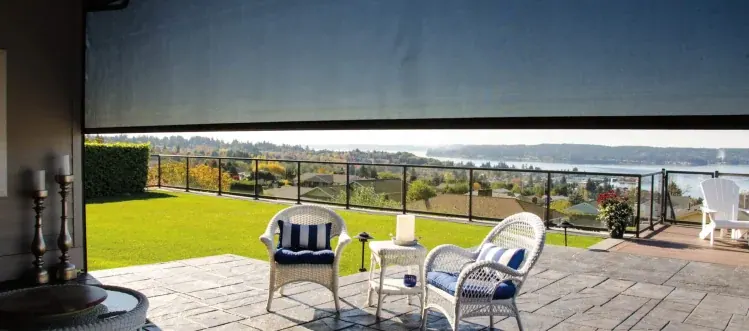
In Austin, motorized outdoor patio shades typically cost between $180 and $200 for standard, off‑the‑shelf sizes up to eight feet wide. Custom‑fit exterior systems that cover larger patios or pergolas can range from $2,500 to $7,500 per opening, fully installed.
Local pricing varies mainly with width, fabric choice, and whether a motorized track system is part of the package.
- DIY & Ready‑Made: Brands such as SmartWings offer motorized outdoor blinds can start around $180 to $200, featuring remote or app control and optional solar or battery power.
- Custom & Professional: Companies like Treaty Oak Shade Company normally charge an estimate $2,500 to $7,500 per opening for heavy‑duty zip‑track systems that block 90 %+ UV and integrate with home automation.
- Labor: Professional measurement and hard‑wiring can add $150 to $400 per shade for installation costs.
- Opening Size: What is the approximate width and height of your patio opening?
- Power Choice: Do you need hard‑wired power or prefer battery/solar options?
Motorized outdoor blinds in Central Texas can cost as little as $180 for a basic unit or climb to an estimated $7,500 for a custom, wind‑rated system. Understanding fabric, motor type, and installation details prevents surprise expenses.
If you live in Austin, West Lake Hills, Lakeway, Bee Cave, Spicewood, Horseshoe Bay, Dripping Springs, or San Marcos, you’ve probably wondered why quotes for motorized outdoor blinds seem to jump from a few hundred dollars to several thousand.
This guide breaks down the real components of a quote, explains why per‑square‑foot math can be misleading, and shows how choices in fabric, power, and layout affect the final bill.
What a $3,500 Motorized Outdoor Blind Quote Example Actually Includes
A $3,500 quote in Austin usually bundles several key items that together deliver a reliable, weather‑proof system. The price covers a zip‑track frame engineered to resist winds up to 75 mph, a motor sized for the blind’s width, and a high‑performance fabric that blocks most UV radiation.
Because Central Texas experiences hot summers and occasional strong gusts, installers must also factor in structural anchoring, electrical wiring, and optional smart‑home integration. These elements protect the blind from damage and keep it operating smoothly for years.
Quote Breakdown
- Frame & Track: Powder‑coated aluminum zip‑track designed for wind resistance and seamless operation.
- Motor Package: Tubular motor with torque adequate for the blind’s width, featuring IP44 protection against dust and moisture.
- Fabric Choice: UV‑blocking mesh with 3 % openness, offering up to 90 % UV reduction while allowing airflow.
- Installation Labor: Precise measurement, mounting on the chosen substrate, and electrical hard‑wiring to a dedicated circuit.
- Smart Integration: Optional Wi‑Fi module compatible with Alexa, Google Assistant, and HomeKit for remote control.
Understanding each line item lets homeowners in Austin and surrounding communities see why a $3,500 quote isn’t just a price tag but a comprehensive solution built for local climate challenges.
Why Price Per Square Foot Misleads More Than It Informs
Many shoppers try to simplify budgeting by dividing the total cost by square footage, but this method ignores critical variables. In Texas, a 10 × 12‑foot patio may require a heavier motor and stronger track than a smaller, sheltered space, skewing the per‑square‑foot figure.
Fabric openness, wind rating, and power source also shift the cost dramatically. A low‑openness, high‑UV‑blocking fabric can cost twice as much per square foot as a basic 5 % openness option, yet it delivers far better performance in Austin’s sun.
Misleading Factors
- Motor Sizing: Larger openings need higher torque motors, increasing cost independent of square footage.
- Wind Rating: High‑wind zip‑track systems carry premium hardware compared with basic cable‑guide setups.
- Fabric Openness: Lower openness fabrics provide better shade but require thicker material and stronger frames.
- Installation Complexity: Sloped roofs or uneven masonry demand custom anchoring, raising labor expenses.
- Smart Features: Adding Wi‑Fi or sensor modules adds a fixed fee, not reflected in a simple area calculation.
When you factor in these variables, the per‑square‑foot metric loses relevance, especially for homeowners across Austin, West Lake Hills, and the Hill Country.
The $800 Difference Between Hardwired and Battery‑Powered Motor Systems
Choosing between a hard‑wired motor and a battery‑powered unit can swing the total project cost by roughly $800. Hard‑wired systems require a dedicated circuit, conduit, and a licensed electrician, while battery‑powered units rely on solar panels or replaceable packs.
In practice, hard‑wired motors deliver consistent torque and eliminate the need for periodic battery replacement, which can be advantageous for larger shades exposed to Austin’s high winds.
A quick comparison of the two power choices highlights the key cost and performance differences
| Power Type | Initial Cost* | Maintenance | Reliability |
|---|---|---|---|
| Hard‑Wired | $2,500–$3,200 | Low (no batteries) | High – consistent torque |
| Battery‑Powered | $1,700–$2,400 | Medium (battery replacement) | Medium – dependent on charge |
| Hybrid (Solar + Battery) | $2,200–$2,900 | Low‑Medium (solar upkeep) | High – renewable energy |
*Illustrative. Actual amounts may vary.
Power Options
- Hard‑Wiring: Requires NEC‑compliant conduit, GFCI protection, and a licensed electrician, adding an estimated $300‑$500 to labor.
- Battery‑Powered: Includes a solar panel kit and rechargeable pack, saving upfront wiring costs but needing annual battery checks.
- Torque Consistency: Hard‑wired motors maintain steady power under load, reducing strain on the fabric during hot days.
- Maintenance Frequency: Battery packs may need replacement every 3‑5 years, adding long‑term expense.
- Aesthetic Impact: Battery units hide all wiring, preserving a clean look for patio installations.
For most Austin homeowners, the extra cost for a hard‑wired system pays off in reliability, especially when the blind must endure frequent summer storms.
How Fabric Grade Changes Your Total Investment by 40%
Fabric selection is the single biggest lever for cost in motorized outdoor blinds. A premium UV‑blocking mesh, such as solution‑dyed acrylic, can cost up to 40 % more than a basic PVC‑coated polyester, yet it resists fading for a decade in Austin’s intense sun.
In addition to price, higher‑grade fabrics offer superior breathability, lower heat gain, and better water runoff, which translates into lower cooling bills and fewer replacements.
Fabric Impact
- UV Protection: Premium fabrics achieve UPF 50+, blocking over 98 % of harmful rays, while lower‑grade options hover around UPF 30.
- Durability: Solution‑dyed acrylic resists mildew and tearing, extending service life by 5‑7 years compared with PVC‑coated polyester.
- Aesthetic Options: Higher‑grade textiles come in a broader palette, allowing homeowners in Spicewood or Horseshoe Bay to match local architecture.
- Cleaning Needs: Premium fabrics repel dust and pollen better, reducing the frequency of rinses during Texas pollen season.
- Cost Ratio: A 10 % openness premium fabric may add $1,200 to a 12 × 12‑foot installation, representing a 40 % increase over a standard option.
Investing in a higher‑grade fabric pays off through durability and comfort, especially for residents of Austin and the surrounding Hill Country who face long, sunny days.
Single Large Shade vs. Multiple Small Ones: The Cost Tradeoff Nobody Mentions
Homeowners often assume a single, oversized shade is cheaper than several smaller units, but the reality is more nuanced. Large spans demand heavier motors, reinforced tracks, and sometimes custom fabrication, driving up material and labor costs.
Conversely, multiple smaller shades can share standard components, reduce motor torque requirements, and allow staggered installation, which can lower the overall price.
Below is a side‑by‑side view of cost drivers for single versus multiple shade configurations
| Configuration | Motor Cost* | Track Cost* | Installation Time |
|---|---|---|---|
| Single Large (20 ft) | $1,200 | $800 | 2 days |
| Three Small (7 ft each) | $900 | $450 | 1.5 days |
| Mixed (12 ft + 8 ft) | $1,050 | $620 | 1.8 days |
*Illustrative. Actual amounts may vary.
Installation Strategies
- Motor Load: A single 20‑foot shade may need a high‑torque motor rated for 30 Nm, while three 7‑foot shades each use 12 Nm motors, saving on motor cost.
- Track Reinforcement: Longer runs require thicker aluminum extrusion and additional bracing, adding an estimated $400‑$600 per foot of extra length.
- Fabric Waste: Cutting a large panel often results in more off‑cut waste, whereas smaller panels can be optimized for minimal scrap.
- Control Flexibility: Multiple shades allow independent scheduling, which can improve energy savings on a west‑facing patio in Lakeway.
- Installation Time: Smaller units can be installed in stages, spreading labor costs and reducing the need for a full‑day crew.
Weighing these factors helps homeowners in Dripping Springs and San Marcos decide whether a single grand shade or a series of modest panels best fits their budget and lifestyle.
Why the Cheapest Motorized Blind Quote Usually Costs More Long‑Term
A low‑ball quote often omits critical components such as wind sensors, higher‑grade motors, or proper sealing. While the upfront price looks attractive, these omissions can lead to premature wear, frequent repairs, and higher energy costs.
In Central Texas, where wind gusts regularly exceed 30 mph, a missing wind sensor can cause a blind to tear or detach, resulting in costly replacements.
Long‑Term Risks
- Wind Sensor Omission: Without automatic retraction, fabric can rip during a storm, leading to an estimated $500‑$1,000 repair bills.
- Under‑Sized Motor: A motor at the edge of its torque rating will overheat, shortening its lifespan to 5,000 cycles instead of 15,000.
- Cheap Fabric: Low‑grade mesh degrades faster under UV exposure, requiring replacement every 3‑4 years.
- Improper Wiring: Skipping NEC‑compliant conduit can cause electrical failures, risking fire hazards and insurance issues.
- Lack of Warranty: Discount providers often for limited warranties, leaving homeowners to foot repair costs themselves.
Choosing a reputable installer who includes these essential features protects your investment and ensures your motorized blinds perform reliably for years across Austin, West Lake Hills, and the surrounding areas.
The Three Hidden Expenses That Appear After Installation
Even after a flawless installation, homeowners encounter costs that rarely appear in the original quote. These hidden expenses stem from routine maintenance, sensor calibration, and occasional component upgrades required by evolving smart‑home ecosystems.
Being aware of these items helps you budget realistically and avoid surprise bills during the first few years of ownership.
Post‑Installation Costs
- Annual Cleaning: Dust and pollen buildup on mesh fabrics in the Hill Country calls for quarterly rinses, which can average $80‑$120 per year.
- Sensor Recalibration: Wind and sun sensors need yearly checks to stay accurate, which can cost $50‑$90 for a technician visit.
- Motor Firmware Updates: Smart‑compatible motors may require subscription‑based firmware services, typically $30‑$60 annually.
- Hardware Replacement: Stainless‑steel fasteners can corrode in humid micro‑climates near Lake Travis, needing replacement every 5‑7 years at an estimated $150‑$250 per job.
- Warranty Extensions: Extending coverage beyond the standard one‑year period adds an estiamted $200‑$400, offering peace of mind for high‑value installations.
Factoring these hidden expenses into your budget ensures that your motorized outdoor blinds remain a source of comfort rather than a financial surprise for residents of Bee Cave, Spicewood, and beyond.
Smart Spending on Outdoor Shades
From the initial quote to long‑term upkeep, understanding each cost component empowers homeowners across Austin and neighboring communities to make informed decisions. By weighing fabric grade, motor type, and installation nuances, you can avoid hidden fees and enjoy reliable shade for years.
Ready to explore a solution tailored to your patio’s size, orientation, and budget? Reach out to Treaty Oak Shade Company for a detailed, no‑surprise estimate and start planning a comfortable outdoor space today.
Author
Lane Frazier is a seasoned professional who has spent two decades installing custom motorized shades for homes throughout the Austin and Hill Country region. His hands‑on experience with a variety of fabrics, motors, and smart‑home integrations gives him a practical perspective on cost and performance. Lane’s insights help homeowners choose solutions that stand up to Central Texas weather while staying within budget.
Ready For a Quote?
Get your custom shade quote Today.
Free, no-pressure consultation. We measure, photograph, and send a written line-item proposal within a week. Most installs ship in 3–5 weeks.
Call the workshop
(512) 939-3446
Mon–Fri · 8a–5p CT · Austin, TX
Prefer to talk it through? Calls are answered by the same team that builds your quote — no call centers, no gatekeepers.
Custom exterior shades, motorized patio screens, awnings, and interior window treatments for Austin and Central Texas.
How To Contact Us
Austin, TX 78734
Monday - Friday 8 AM - 5 PM
navigate
Copyright © 2026 | Treaty Oak Shade Co. All Rights Reserved. | Privacy Policy