
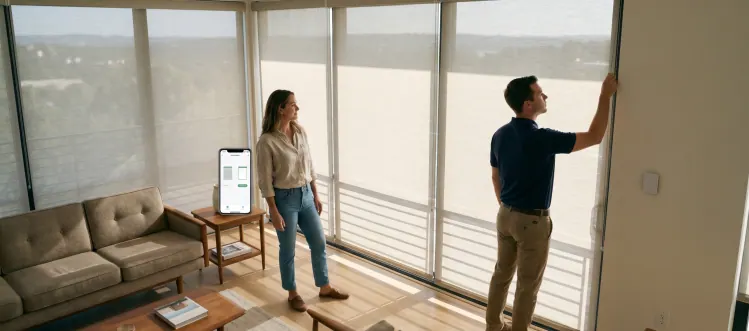
Motorized shades in Austin reduce harsh solar glare and lower energy bills through automated scheduling, sun sensors, and smart home integration. Operating via smartphone apps, remotes, or voice commands, these 100% cordless window treatments provide essential child and pet safety while easily servicing difficult-to-reach or oversized windows.
- Smart Home Integration: Syncs with Apple Home, Google Assistant, or Amazon Alexa, using quiet motors like Somfy or Lutron for automatic adjustments based on time or temperature.
- Energy Efficiency: Combat intense Texas heat, especially on west‑facing windows, with cellular or solar shades that add insulation and block UV rays while preserving Hill Country views.
- Power Options: Choose low‑voltage hardwired installs for new builds or battery‑powered setups for retrofits, offering flexibility for any project.
- Custom Fabric & Style: From sleek motorized rollers to soft Roman shades, select openness from 1% blackout to 10% light‑filtering to match décor and privacy needs.
- Window Orientation: Identify which direction your windows face, such as west, to select the right solar performance.
- Budget & Fabric: Define your price range and preferred material to guide product selection.
- Indoor vs Outdoor: Decide whether you need indoor window shades or exterior patio screens for full‑home comfort.
Motorized shades cut glare, save energy, and boost safety with smart scheduling and cordless design. Understanding integration, power, fabric, and placement helps you choose the right system for Texas homes.
Ever stared at a sun‑blasted living room in Austin and wondered if there was a simpler way to keep the heat out? Motorized shades promise a hands‑free solution, but the real value lies in the details that most shoppers overlook.
In this guide we’ll unpack the hidden drivers of performance, from motor protocols to wind sensors, and show how each feature translates into comfort, savings, and peace of mind for homeowners across Austin, West Lake Hills, Lakeway, Bee Cave, Spicewood, Horseshoe Bay, Dripping Springs, and San Marcos.
Why Smart Home Integration Fails Without the Right Motor Protocol
Smart home platforms promise seamless control, yet many Texas homeowners discover that their motorized shades won’t respond as expected. The root cause often lies in the motor’s communication protocol, which may not align with the hub’s language.
In practice, a mismatch can lead to delayed commands, missed schedules, or complete loss of control during power spikes. Understanding the protocol ensures reliable operation and protects the investment.
Protocol Pitfalls
- Protocol Mismatch: Motors using proprietary RF can clash with Matter‑compatible hubs, causing intermittent connectivity.
- Signal Interference: Dense construction materials in West Lake Hills homes can block RF signals, requiring repeaters or wired backups.
- Firmware Updates: Outdated motor firmware may not support new voice‑assistant features, limiting automation potential.
- Battery Drain: Some protocols keep the motor in standby mode, reducing battery life for retrofit installations.
- Security Risks: Unencrypted RF can expose shade positions to nearby devices, a concern for privacy‑focused owners.
The takeaway is clear: verify that the motor you choose speaks the same language as your smart ecosystem before signing any contract. Doing so avoids costly retrofits and guarantees the smooth, automated experience you expect.
The Quiet Motor Myth: What Decibel Ratings Don't Tell You
Many brochures highlight a motor’s decibel rating, suggesting a quiet operation, yet real‑world performance can differ dramatically. The perception of noise depends on mounting, housing, and the speed profile of the motor.
In practice, a motor rated at 35 dB may still produce a noticeable whine if the shade is oversized or the mounting is loose. Homeowners in Austin’s hot climate often notice these nuances during early morning or late evening adjustments.
Beyond Decibels
- Mounting Isolation: Using rubber grommets or silicone pads can absorb vibrations, reducing perceived noise.
- Gear Design: Planetary gearboxes tend to run smoother than worm gears, especially under heavy loads.
- Speed Settings: Slower opening speeds lower motor strain and audible output, a useful feature for night‑time operation.
- Fabric Interaction: Heavy blackout fabrics generate more friction, increasing motor effort and sound.
- Environmental Factors: High summer temperatures can cause motor bearings to expand, subtly raising noise levels.
When evaluating quietness, ask installers about mounting details and gear types, not just the spec sheet. A well‑installed system will whisper, while a cheap install may shout.
How Wind Sensors Prevent Shade Damage Better Than Any Warranty
Exterior motorized shades face a unique threat: gusts that can yank a fabric off its track. Traditional warranties cover mechanical failure, but they rarely address wind‑induced damage.
A wind sensor that detects pressure changes can automatically retract a shade before a gust exceeds safe limits. This proactive approach saves both the shade and the homeowner from costly repairs.
Sensor Benefits
- Early Detection: Sensors monitor ambient wind speed and trigger retraction at preset thresholds.
- Energy Savings: By closing during high winds, the system reduces heat gain, complementing energy‑efficiency goals.
- Longevity: Reducing mechanical stress extends motor life, often beyond the warranty period.
- Safety: Prevents sudden fabric snaps that could injure children or pets.
- Automation Integration: Sensors can be linked to smart hubs, allowing users to receive alerts before the shade moves.
Investing in wind sensors is a small upfront cost that pays dividends in durability and peace of mind, especially for patio enclosures in exposed Hill Country locations.
Battery Backup vs. Hardwired: Which Actually Saves You Money Long‑Term
Choosing between a battery‑powered motor and a hardwired low‑voltage system is often framed as a cost question, yet the true financial picture includes maintenance, energy consumption, and lifespan.
In practice, battery units avoid the expense of an electrician but may need replacement every few years, while hardwired installations incur higher upfront costs but typically enjoy lower operating expenses.
Cost Factors
- Installation Fees: Hardwired setups require licensed electricians, adding an estimated $150‑$300 per window in Austin.
- Battery Replacement: Rechargeable packs lose capacity after 500 cycles, often needing replacement every 3‑4 years.
- Energy Draw: Low‑voltage hardwired motors consume less standby power, saving up to 5 % on annual electricity bills.
- Warranty Coverage: Some manufacturers extend warranties for hardwired units, reducing long‑term service costs.
- Retrofit Flexibility: Battery units excel in historic homes where wiring upgrades are impractical.
Run the numbers for your specific home layout; for large, south‑facing windows a hardwired solution usually offers the best return, while smaller, retrofit projects may favor battery convenience.
The Remote Control Feature Most Homeowners Regret Not Having
Most shade owners start with a basic wall switch, only to discover later that a universal remote could have simplified daily routines. The missing feature is often a programmable scene button that toggles multiple shades at once.
In practice, without scene control, you may need to adjust each shade individually, wasting time and negating the convenience that motorized systems promise.
Missing Scene Buttons
- One‑Touch Sunsets: A single button that closes all east‑facing shades at dusk, protecting furniture from UV.
- Morning Wake‑Up: Opens bedroom shades gradually, syncing with smart alarms for a gentle sunrise.
- Privacy Mode: Simultaneously lowers all ground‑level shades for evening gatherings.
- Energy Saver: Closes exterior screens when indoor temperature exceeds a set point, reducing cooling load.
- Accessibility: Allows users with limited mobility to control multiple windows without walking across the house.
When planning your shade system, ask the installer about scene‑capable remotes or wall panels. It’s a small addition that dramatically enhances everyday usability.
Why Somfy and Lutron Motors Command Higher Prices in Texas Heat
Premium motor brands like Somfy and Lutron often carry a price premium, but their engineering addresses the harsh Texas climate where temperatures regularly exceed 100 °F. The higher cost reflects durability, torque, and thermal management.
In practice, these motors maintain consistent speed and torque even when ambient heat pushes internal components toward their limits, preventing stalls that cheaper units may suffer.
Performance Advantages
- Thermal Protection: Integrated heat sinks and temperature sensors shut down the motor before overheating.
- High Torque: Designed to lift heavy blackout fabrics without strain, ensuring reliable operation.
- Quiet Gearboxes: Precision‑machined gears reduce vibration, keeping noise low even on large installations.
- Smart Diagnostics: Built‑in error reporting alerts homeowners to potential issues before failure.
- Extended Warranty: Many premium motors include longer warranty periods, reflecting confidence in longevity.
For homeowners in Austin’s sun‑baked neighborhoods, the extra investment translates into fewer service calls and a smoother, quieter experience over the motor’s life.
Group Control Settings That Turn Eight Shades Into One Simple System
Managing multiple shades individually can become a chore, especially in open‑plan homes with large windows. Group control consolidates commands, allowing a single instruction to move several shades in sync.
In practice, a group‑controlled system can lower energy use by coordinating shade positions based on solar angle, while also simplifying daily routines for busy families.
Group Benefits
- Unified Scenes: One button can set a “Movie Night” mode, dimming lights and lowering all living‑room shades.
- Energy Coordination: Sensors trigger a group to close when indoor temperature exceeds a threshold, reducing HVAC load.
- Simplified Programming: Users set a single schedule for a group, avoiding the need to program each shade separately.
- Reduced Wiring: Shared control lines cut installation time and material costs for large homes.
- Enhanced Safety: Group commands can quickly close all shades during a storm, protecting fabrics from wind damage.
Implementing group control turns a complex array of shades into an intuitive, single‑point system, delivering both convenience and energy savings for Texas homeowners.
Smart Shade Investment Wins
We’ve explored how integration, noise, wind protection, power choice, remote flexibility, premium motors, and group control each contribute to the overall value of motorized shades. Understanding these features helps you avoid common pitfalls and choose a system that truly fits your Austin‑area home.
Ready to upgrade your windows? Explore our services, from exterior privacy screens to custom patio awnings, and let the experts at Treaty Oak Shade Company guide you through a hassle‑free installation that maximizes comfort and savings.
Author
Lane Frazier is the owner of Treaty Oak Shade Company, a specialist in motorized shade solutions for the Hill Country. With two decades of hands‑on experience installing custom systems across Austin, West Lake Hills, and surrounding communities, Lane brings practical insight into how each feature impacts daily life and long‑term performance.
Ready For a Quote?
Get your custom shade quote Today.
Free, no-pressure consultation. We measure, photograph, and send a written line-item proposal within a week. Most installs ship in 3–5 weeks.
Call the workshop
(512) 939-3446
Mon–Fri · 8a–5p CT · Austin, TX
Prefer to talk it through? Calls are answered by the same team that builds your quote — no call centers, no gatekeepers.
Custom exterior shades, motorized patio screens, awnings, and interior window treatments for Austin and Central Texas.
How To Contact Us
Austin, TX 78734
Monday - Friday 8 AM - 5 PM
navigate
Copyright © 2026 | Treaty Oak Shade Co. All Rights Reserved. | Privacy Policy