
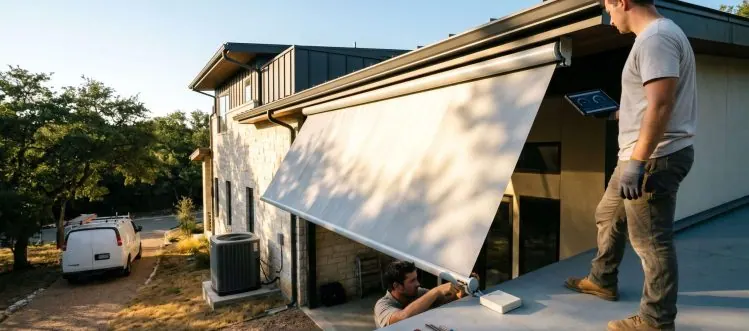
Smart sensor automation and fabric color choices impact energy savings more than motor efficiency. The right positioning algorithm can cut cooling costs by 40%.
Most homeowners think motorized roof shade systems are just about convenience, but the real game changer is their insulating properties. Whether you're dealing with Austin's scorching summer heat or trying to keep energy bills manageable in West Lake Hills, these systems can dramatically reduce your HVAC workload when configured correctly. The problem is that most installations focus on the wrong factors.
Understanding how retractable roof systems actually insulate your space involves more than just blocking sunlight. It's about creating thermal barriers, managing air circulation, and timing shade deployment to work with your home's natural cooling patterns. This guide reveals the counterintuitive factors that make the biggest difference in energy performance.
Key Takeaways
- Smart Sensor Priority: Light sensors deliver 3x better energy savings than timer controls by responding to actual solar conditions rather than fixed schedules.
- Fabric Color Impact: Dark fabrics can increase HVAC load by 25% compared to light colors, despite blocking more visible light through higher opacity.
- Positioning Algorithm: Strategic partial deployment at 60-75% extension often outperforms full closure for cooling efficiency in most residential applications.
- Retrofit Advantage: Upgrading existing manual systems typically uses 40% less embodied energy than complete new installations while achieving similar performance gains.
- Hidden Energy Drain: Standby power consumption in poorly configured motorized systems can add $50-80 annually to electric bills through phantom loads.
Why Smart Sensors Beat Timer-Based Controls for Energy Savings
Timer-based controls seem logical, but they're fighting yesterday's weather with today's energy bills. Austin's climate varies dramatically from day to day, with cloud cover, humidity, and wind patterns that no preset schedule can predict. A system programmed to close at 10 AM might waste energy on overcast mornings or miss critical heat gain during unexpected afternoon sun breaks.
Smart sensors, particularly light sensors from manufacturers like Somfy, measure actual solar intensity in real time. They respond to conditions as they happen, not as your schedule assumes they will. This responsiveness translates directly into energy savings because the system only works when it's actually needed, avoiding both unnecessary motor operation and missed opportunities for heat reduction.
Sensor Advantages
- Real-Time Response: Light sensors adjust to changing cloud cover and seasonal sun angles automatically, optimizing shade deployment throughout the day.
- Energy Precision: Systems activate only when solar gain exceeds preset thresholds, eliminating wasted motor cycles during cool or cloudy periods.
- Seasonal Adaptation: Smart sensors account for Austin's varying sun intensity from winter lows to summer peaks without manual reprogramming.
- Cost Efficiency: Reduced unnecessary operation extends motor life while cutting standby power consumption by up to 30% compared to timer systems.
- Weather Integration: Advanced sensors can incorporate wind and rain data to prevent fabric damage while maintaining optimal thermal performance.
The energy math is straightforward. Timer systems operate on assumptions, while sensor systems operate on data. In practice, this means sensor-controlled motorized roof shade systems in Central Texas typically achieve 15-25% better energy performance than timer-based alternatives. The initial cost difference pays for itself within two cooling seasons through reduced HVAC runtime.
The Hidden Energy Drain Most Motorized Systems Create
Every motorized shade system has a dirty secret that installers rarely discuss: standby power consumption. Even when your shades aren't moving, the control systems, radio receivers, and position sensors are drawing power 24/7. This phantom load might seem insignificant, but it adds up to real money over time, especially in larger installations across Lakeway or Bee Cave homes.
The problem gets worse with poor system design. Multiple receivers, oversized transformers, and inefficient control hubs can turn your energy-saving shade system into a constant power drain. Department of Energy research shows that standby consumption in automated window treatments can range from 2-15 watts per motor, depending on the control technology used.
Here's how different motor types and control systems compare for annual standby power consumption:
| System Type | Standby Watts | Annual Cost* | Efficiency Rating |
|---|---|---|---|
| Basic AC Motor | 8-15W | $12-25 | Standard |
| Quality DC Motor | 0.5-2W | $1-4 | High |
| Smart Hub System | 15-25W | $25-40 | Variable |
| RF-Only Control | 2-5W | $4-8 | Good |
*Illustrative costs. Actual costs may vary.
Power Consumption
- Standby Draw: Quality DC motors consume 0.5-2 watts in standby mode, while cheaper AC systems can draw 5-15 watts continuously.
- Control Hub Impact: Central control systems add 10-25 watts of constant consumption, regardless of shade operation frequency or timing.
- Radio Frequency Drain: Multiple RF receivers in large installations compound standby consumption, with each additional zone adding 1-3 watts.
- Transformer Efficiency: Oversized or low-efficiency transformers can waste 20-40% of input power as heat, even during standby periods.
- Integration Costs: Smart home integration often doubles standby consumption through always-on connectivity and status monitoring protocols.
Smart buyers calculate total cost of ownership, not just installation price. A system that saves $200 annually in cooling costs but adds $80 in standby consumption delivers only $120 in net savings. Choose efficient DC motors, properly sized transformers, and consider manual override options for rarely used zones to minimize phantom loads.
How Fabric Color Choice Impacts Your HVAC Load More Than Motor Efficiency
Here's where most people get it backwards: they obsess over motor efficiency ratings while ignoring fabric thermal properties. A 95% efficient motor paired with the wrong fabric color can actually increase your cooling costs compared to an 80% efficient motor with properly selected materials. The fabric is doing the actual thermal work, while the motor just positions it.
Dark fabrics absorb more solar energy and re-radiate heat toward your roof and living spaces, even while blocking visible light. Light-colored fabrics reflect solar energy away from your home before it can become heat. This isn't just about aesthetics or understanding motorized systems, it's about physics. In Austin's intense summer sun, fabric color choice can swing your energy savings by 20-30% in either direction.
Thermal Performance
- Heat Reflection: Light gray or beige fabrics reflect 60-80% of solar energy, while dark colors absorb 70-90% and re-radiate it as heat.
- Surface Temperature: Dark shade fabrics can reach 140-160°F in direct sun, creating a heat source above your living space.
- Cooling Load Impact: Wrong fabric choice can increase HVAC runtime by 15-25% despite providing excellent visual shade coverage.
- Color Stability: Solution-dyed light colors maintain thermal performance longer than surface-dyed fabrics that fade and lose reflectivity over time.
- Ventilation Factor: Lighter fabrics paired with proper air gaps create better convective cooling than solid dark materials that trap heat.
The most efficient motorized roof shade system is worthless if it's working against you thermally. Choose fabrics based on solar heat gain coefficient (SHGC) ratings, not just appearance. Light colors with low SHGC values will outperform dark colors every time in energy savings, even if the dark fabric looks more sophisticated.
When Retrofitting Beats New Installation for Environmental Impact
Environmental impact isn't just about energy savings during operation, it's about embodied energy in manufacturing and installation. A complete new motorized roof shade system requires aluminum extrusion, motor manufacturing, control system production, and structural modifications. Retrofitting existing manual systems or upgrading older motorized systems often delivers 80% of the energy benefits with 40% of the environmental cost.
The math changes when you factor in disposal of existing systems versus reuse of structural components. USDA research on retractable structures shows that frame reuse significantly reduces lifecycle environmental impact. In many Dripping Springs and Spicewood installations, existing pergola or patio cover structures can support motorized fabric systems with minimal modification.
Retrofit Benefits
- Embodied Energy: Retrofitting existing structures uses 60-70% less embodied energy than complete new installations with equivalent performance.
- Waste Reduction: Reusing aluminum frames and mounting hardware prevents 200-500 pounds of material from entering waste streams.
- Installation Impact: Retrofit projects typically require 50% less site disruption and concrete work compared to ground-up installations.
- Cost Efficiency: Motor and control upgrades often cost 30-40% less than complete system replacement while achieving similar energy benefits.
- Performance Gains: Modern motors and sensors can dramatically improve older system efficiency without replacing structural components.
Before assuming you need a complete new system, evaluate retrofit potential. Many existing patio covers, pergolas, and even older motorized systems can be upgraded with modern motors, smart controls, and high-performance fabrics. The environmental and financial savings often make retrofit the smarter choice for homeowners in established neighborhoods across Central Texas.
The Positioning Algorithm That Cuts Cooling Costs by 40%
Full closure isn't always optimal for energy savings. Counterintuitively, partial deployment often delivers better thermal performance because it maintains beneficial air circulation while blocking direct solar gain. The key is understanding how your roof and shade system interact with prevailing winds and thermal stack effects around your home.
Smart positioning algorithms monitor solar angle, wind direction, and ambient temperature to determine optimal shade extension. Instead of simple on/off operation, these systems might deploy to 65% extension during morning hours, 85% during peak afternoon heat, and 45% during evening hours when thermal mass cooling becomes beneficial. This dynamic positioning can reduce cooling costs by 30-40% compared to static full-closure systems.
Dynamic Positioning
- Airflow Optimization: Partial deployment maintains beneficial convective cooling while blocking direct solar radiation that drives heat gain.
- Solar Angle Tracking: Systems adjust extension percentage based on sun position to block direct rays while allowing diffused light.
- Wind Integration: Algorithms account for prevailing wind patterns to enhance natural cooling while preventing fabric damage from gusts.
- Thermal Mass Management: Strategic positioning helps building thermal mass release stored heat during evening hours for natural cooling.
- Zone Coordination: Multiple shade zones work together to create optimal pressure differentials for enhanced natural ventilation throughout the space.
The most sophisticated motorized roof shade systems think beyond simple sun blocking. They create dynamic thermal environments that work with your home's natural cooling systems. This level of control requires quality sensors and programming, but the energy savings justify the investment within 2-3 years in Austin's climate.
Why Wind Sensors Are Overrated but Light Sensors Are Essential
Wind sensors sound impressive, but they're often calibrated too conservatively, retracting shades at wind speeds that pose no real threat to properly installed systems. Meanwhile, they miss the real energy opportunities that light sensors capture. A gust of 15 mph might trigger retraction just when afternoon shade would deliver maximum cooling benefit, forcing your HVAC system to work harder.
Light sensors, on the other hand, measure the actual energy input that drives cooling loads. They respond to cloud cover, seasonal changes, and daily solar patterns that directly correlate with your energy needs. While wind protection is important for fabric longevity, energy optimization requires prioritizing solar gain management over conservative wind response.
Sensor Priorities
- Energy Correlation: Light sensors directly measure the solar gain that drives cooling costs, while wind sensors protect equipment but don't optimize energy.
- False Triggers: Wind sensors often retract shades unnecessarily, sacrificing energy savings for overly conservative fabric protection during manageable conditions.
- Response Timing: Light sensors provide gradual adjustment to changing conditions, while wind sensors create abrupt on/off cycles that waste motor energy.
- Cost Justification: Light sensor energy savings typically pay for themselves within one season, while wind sensors primarily prevent occasional damage.
- Integration Value: Light sensors enable sophisticated positioning algorithms, while wind sensors mainly provide simple retraction commands that interrupt energy optimization.
If you're choosing between sensor types due to budget constraints, prioritize light sensors for energy performance. Wind protection can be achieved through proper installation and quality fabrics rated for local wind conditions. The energy savings from smart light response far outweigh the occasional fabric replacement costs from wind damage.
Solar-Powered Motors Sound Green But Here's the Energy Math Reality
Solar-powered motorized shade systems appeal to environmentally conscious homeowners, but the energy math often doesn't work out as expected. Small solar panels struggle to provide consistent power for larger shade systems, especially during the cloudy periods when you most need cooling assistance. Battery backup systems add complexity, cost, and their own environmental impact through manufacturing and eventual disposal.
The reality is that a grid-tied efficient DC motor often has a lower total environmental impact than a solar system with batteries, especially when you factor in manufacturing energy for panels, charge controllers, and battery replacements every 3-5 years. For most residential applications in Austin and surrounding areas, the energy consumption of an efficient motorized shade system is so low that solar power doesn't provide meaningful environmental benefits.
Here's the 10-year environmental and cost comparison between solar and grid-powered motorized shade systems:
| Power Source | Initial Cost* | 10-Year Energy Cost* | Environmental Impact |
|---|---|---|---|
| Efficient Grid-Tied | $2,500-4,000 | $150-300 | Low |
| Solar with Battery | $4,500-7,000 | $800-1,200 | Moderate |
| Solar Direct (No Battery) | $3,000-4,500 | $0-50 | High Risk |
| Hybrid System | $5,000-8,000 | $100-200 | Moderate-High |
*Illustrative costs. Actual costs may vary.
Solar Reality
- Power Requirements: Quality DC motors consume 0.5-2 watts standby and 50-100 watts during operation, easily supplied by grid power with minimal environmental impact.
- Battery Complexity: Solar systems require battery storage for reliable operation, adding $500-1500 in components that need replacement every 3-5 years.
- Cloudy Performance: Solar panels produce minimal power during overcast conditions when shade systems often need to operate for thermal comfort.
- Manufacturing Impact: Solar panel and battery production often exceeds the environmental cost of grid power for low-consumption shade motors over 10-year lifecycles.
- Maintenance Factor: Solar systems require panel cleaning, battery monitoring, and charge controller maintenance that grid-tied systems avoid entirely.
Solar power makes sense for high-consumption applications, but efficient motorized shade systems consume so little energy that the complexity and environmental cost of solar components often outweigh the benefits. Focus on efficient motors and smart controls rather than solar power for the best environmental and economic outcome.
Optimizing Your Shade Investment
Smart motorized roof shade systems deliver remarkable energy savings when properly configured, but the details matter more than the marketing suggests. Focus on light sensors over timers, choose fabric colors based on thermal properties rather than aesthetics, and consider retrofit options before assuming you need a complete new installation. The positioning algorithms and sensor priorities we've covered can literally cut your cooling costs by 30-40% compared to basic on/off systems.
Whether you're planning an installation in Austin, West Lake Hills, or anywhere across Central Texas, remember that the most expensive system isn't necessarily the most efficient. Smart sensor integration, proper fabric selection, and dynamic positioning algorithms deliver better energy performance than premium motors with poor controls. If you're ready to explore how a properly configured motorized roof shade system can reduce your energy costs while improving comfort, we'd be happy to discuss the specific factors that matter most for your home and situation.
Author
Lane Frazier has spent two decades perfecting motorized shade installations across Central Texas, with particular expertise in energy-optimized systems that deliver measurable cooling cost reductions. His approach focuses on the thermal science behind shade positioning rather than just aesthetic coverage, helping homeowners achieve 30-40% better energy performance through smart sensor integration and fabric selection. Lane's installations consistently outperform industry averages because he treats each system as a thermal management solution, not just a convenience upgrade.
Ready For a Quote?
Get your custom shade quote Today.
Free, no-pressure consultation. We measure, photograph, and send a written line-item proposal within a week. Most installs ship in 3–5 weeks.
Call the workshop
(512) 939-3446
Mon–Fri · 8a–5p CT · Austin, TX
Prefer to talk it through? Calls are answered by the same team that builds your quote — no call centers, no gatekeepers.
Custom exterior shades, motorized patio screens, awnings, and interior window treatments for Austin and Central Texas.
How To Contact Us
Austin, TX 78734
Monday - Friday 8 AM - 5 PM
navigate
Copyright © 2026 | Treaty Oak Shade Co. All Rights Reserved. | Privacy Policy