
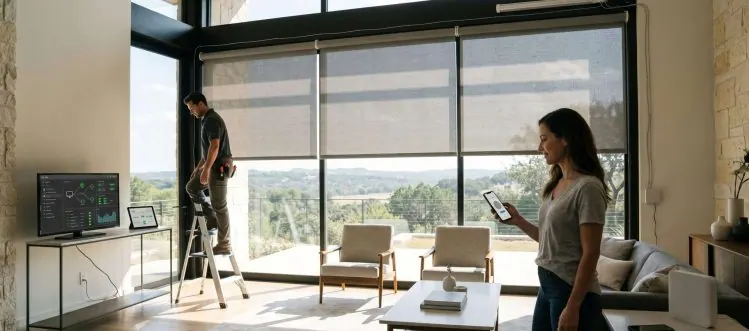
Most smart home failures happen because motorized shades use incompatible protocols. Professional installation ensures seamless integration with existing systems.
Smart home enthusiasts often discover their carefully planned automation dreams crumble when motorized shades won't sync with their existing systems. You've invested thousands in home automation hubs, voice assistants, and connected devices, only to find your new shades operate in isolation like digital islands. The frustration builds when simple commands like 'close the living room shades' result in confused silence from your smart assistant.
The reality is that motorized shades represent one of the most complex integration challenges in modern home automation, requiring careful protocol matching, power planning, and network configuration. Whether you're upgrading a home in Austin's tech-forward neighborhoods or building new in Lakeway, understanding how these systems truly connect determines whether your automation enhances daily life or becomes an expensive source of ongoing frustration.
Key Takeaways
- Protocol Compatibility: Most shade integration failures stem from mismatched communication protocols between motors and existing smart home hubs, requiring careful pre-planning before purchase.
- Power Management: Battery-powered shades offer installation flexibility but require charging schedules, while hardwired systems provide consistent operation with higher upfront electrical work.
- Manual Override Systems: Quality motorized shades include multiple backup control methods to ensure operation during power outages, network failures, or smart home system malfunctions.
- Voice Control Reality: Daily usage patterns show voice commands work best for simple up/down operations, while app control handles complex scheduling and scene management more effectively.
- Professional Installation Value: DIY mistakes with motor torque calculations, limit programming, and network configuration often cost more to fix than hiring experienced installers initially.
Why Smart Home Integration Fails Without Proper Shade Motor Protocols
The biggest shock for new smart home owners happens when they realize their $50,000 automation system can't communicate with their motorized shades. This disconnect occurs because shade manufacturers often use proprietary radio frequencies like RTS (Radio Technology Somfy) or Z-Wave protocols that don't naturally speak the same language as popular hubs like SmartThings, Hubitat, or Control4. What seems like a simple 'smart shade' purchase becomes a complex translation problem requiring bridges, gateways, or complete protocol overhauls.
In practice, successful integration requires understanding that Somfy motors operate on 433.42 MHz RTS while many home automation systems default to Z-Wave (908 MHz) or Zigbee (2.4 GHz) frequencies. The solution involves either selecting shades that natively support your existing protocol or investing in bridge devices that translate between systems. This planning step, often skipped during initial purchases, determines whether your shades become seamlessly automated or remain manually controlled expensive window coverings.
Integration Challenges
- Protocol Mismatch: RTS-based Somfy motors require dedicated bridges to communicate with Z-Wave or Zigbee hubs, adding complexity and potential failure points.
- Network Congestion: Adding multiple wireless shades to already crowded 2.4 GHz networks can cause response delays and missed commands during peak usage.
- Range Limitations: RF signals from shade motors may not reach centrally located hubs in larger homes, requiring repeaters or mesh network planning.
- Firmware Updates: Smart shade motors need regular firmware updates that can temporarily break hub communication until bridge software catches up.
- Scene Complexity: Programming multiple shades to operate in coordinated scenes often exceeds basic hub capabilities, requiring advanced automation platforms.
The key insight most installers miss is that protocol compatibility should drive shade selection, not the reverse. Starting with your existing automation platform and working backward to compatible shade options prevents the expensive retrofitting that plague many smart home projects. When planned correctly, motorized shades become the crown jewel of home automation rather than its most frustrating component.
The Hidden Power Draw That Surprises Most Homeowners
Most homeowners assume motorized shades only consume power during the brief moments they're actually moving up or down. The surprise comes when they discover these systems maintain constant network connections, run positioning sensors, and power standby circuits that collectively draw 2-5 watts per shade around the clock. Multiply that by 15-20 shades in a typical Austin home, and you're looking at 30-100 watts of continuous consumption, equivalent to running several LED light bulbs 24/7.
Battery-powered systems present different power challenges that catch users off guard. Lithium battery wands in quality motorized shades typically last 6-12 months between charges, but this varies dramatically based on usage patterns, temperature extremes, and network connectivity demands. A shade that operates twice daily in moderate conditions might need charging every 8 months, while one handling frequent adjustments in a sun-drenched west-facing window could require monthly attention.
Power Considerations
- Standby Consumption: Hardwired shades draw 2-5 watts continuously for network connectivity and motor readiness, adding $15-40 annually per shade to energy bills.
- Battery Degradation: Rechargeable battery performance decreases 10-15% annually, requiring more frequent charging cycles as systems age beyond three years of use.
- Temperature Impact: Extreme heat above 90°F or cold below 40°F can reduce battery life by 30-50%, particularly affecting shades in uninsulated spaces.
- Network Polling: Shades connected to busy automation networks consume additional power responding to status requests and maintaining mesh connections every few seconds.
- Charging Logistics: Battery-powered systems require planning for charging schedules, especially in hard-to-reach installations or homes with many automated shades.
Understanding power requirements upfront helps homeowners make informed decisions between battery and hardwired systems. Hardwired installations offer worry-free operation but require electrical planning, while battery systems provide installation flexibility at the cost of ongoing maintenance. The choice often depends on whether convenience or long-term simplicity takes priority in your automation strategy.
Manual Override Systems: Your Safety Net When Automation Goes Wrong
The moment your smart home system crashes during a power outage or network failure, you'll appreciate having multiple ways to control your motorized shades manually. Quality systems include physical wall switches, handheld remotes, and mechanical override options that function independently of your main automation hub. This redundancy becomes critical when you need emergency egress from bedrooms with blackout shades or when guests need to adjust shades without accessing your smart home app.
Professional-grade motorized shades often include a manual chain or crank mechanism hidden within the headrail that allows completely mechanical operation when electronics fail. This feature, frequently overlooked during selection, can mean the difference between being trapped behind blackout shades during an emergency and having multiple exit options. The manual override also proves invaluable during system updates, network maintenance, or when troubleshooting automation problems.
Backup Controls
- Physical Wall Switches: Hardwired wall controls operate independently of network connectivity, providing reliable shade control during Wi-Fi outages or hub failures.
- Handheld Remotes: Dedicated RF remotes bypass network dependencies and work directly with shade motors, functioning even when smart home systems are offline.
- Mechanical Override: Hidden manual chains or cranks allow completely non-electronic operation for emergency situations or complete system failures requiring immediate shade adjustment.
- Multi-Channel Remotes: Single remotes can control multiple shade groups, providing backup control for entire rooms without requiring individual shade programming or network access.
- Battery Backup: Some hardwired systems include battery backup modules that maintain basic up/down functionality during power outages for essential egress windows.
The best motorized shade systems anticipate failure scenarios and provide multiple control pathways that don't depend on perfect network connectivity or power availability. This redundancy transforms shades from potential safety hazards into reliable home components that enhance security and convenience regardless of external circumstances.
How Wind Sensors Transform Motorized Shades from Convenience to Necessity
Austin's unpredictable weather patterns, from sudden thunderstorms to intense heat, make wind sensors essential for exterior motorized shades rather than optional upgrades. These sensors automatically retract shades when wind speeds exceed safe thresholds, preventing expensive damage from unexpected gusts that can tear fabric or bend hardware. Without this protection, a single severe weather event can destroy thousands of dollars in automated blinds and potentially create dangerous projectiles.
Modern wind sensors integrate seamlessly with home automation systems, sending alerts to smartphones when weather conditions trigger automatic retraction. This intelligence extends beyond simple wind detection to include rain sensors that protect fabric from moisture damage and sun sensors that automatically deploy shades during intense UV periods. The result transforms reactive shade operation into proactive climate protection that operates whether you're home or traveling.
Here's how different wind sensor thresholds affect shade protection and usability:
| Wind Speed Threshold | Protection Level | Usage Impact |
|---|---|---|
| 10-15 mph | Conservative | Frequent retractions, high protection |
| 15-25 mph | Balanced | Moderate retractions, good protection |
| 25-35 mph | Aggressive | Rare retractions, minimal protection |
Sensor Integration
- Automatic Retraction: Wind sensors trigger immediate shade retraction at preset speeds (typically 15-25 mph), preventing fabric damage and hardware stress during storms.
- Weather Monitoring: Advanced systems combine wind, rain, and temperature sensors to create comprehensive weather response protocols that protect shades and interior spaces.
- Smart Notifications: Sensor-triggered events send smartphone alerts explaining why shades retracted, helping homeowners understand system responses and weather conditions.
- Override Protection: Safety sensors cannot be overridden by manual commands during dangerous conditions, ensuring protection even when users attempt manual deployment during storms.
- Calibration Flexibility: Professional installation includes sensor calibration for local wind patterns, accounting for building orientation and surrounding landscape features affecting wind flow.
Wind sensors represent the difference between motorized shades as luxury convenience and as intelligent building protection systems. In climates like Austin's, where weather can change rapidly, these sensors provide peace of mind and asset protection that justifies their additional cost through prevented damage and extended system lifespan.
The 15-Second Rule That Separates Quality Motors from Cheap Ones
Professional installers use a simple test to evaluate motor quality: how smoothly and quietly a shade travels its full range in under 15 seconds. Quality motors like those from Somfy or Lutron maintain consistent speed throughout the entire travel range, while cheaper alternatives often start fast, slow down mid-travel, or exhibit jerky movement that indicates inadequate torque or poor gear reduction. This performance difference becomes more pronounced over time as inferior motors develop dead spots or require multiple activation attempts.
The 15-second benchmark also reveals motor longevity indicators that affect long-term satisfaction and maintenance costs. Premium motors achieve this speed while operating below 40 dB(A), making them virtually silent during operation. Cheap motors often exceed 50 dB(A) and develop additional noise over time as gears wear and bearings degrade. This noise difference becomes particularly important in bedrooms or quiet spaces where shade operation shouldn't disturb occupants.
Performance Metrics
- Speed Consistency: Quality motors maintain uniform 6-9 inches per second travel speed throughout the entire range, while cheap motors vary speed unpredictably.
- Noise Levels: Premium motors operate at 38-42 dB(A), comparable to a quiet library, while budget options often exceed 50 dB(A) and worsen over time.
- Torque Reliability: High-quality motors provide consistent lifting force regardless of fabric weight or environmental conditions, preventing mid-travel stops or hesitation.
- Limit Accuracy: Professional-grade motors return to exact positions within 1-2mm repeatability, while cheaper alternatives can drift several inches from programmed limits.
- Thermal Protection: Quality motors include overload protection that prevents damage from excessive use, while basic motors can burn out from repeated operation.
The 15-second rule provides an immediate quality assessment that predicts long-term performance and satisfaction. Motors that pass this test typically offer 15-20 year lifespans with minimal maintenance, while those that fail often require replacement within 3-5 years. This performance difference makes quality motors a better investment despite higher initial costs.
Voice Control vs. App Control: Which Actually Gets Used Daily
Real-world usage data reveals a surprising split in how people actually control their motorized shades after the novelty period ends. Voice commands dominate simple, immediate actions like 'close the bedroom shades' or 'open the living room blinds,' accounting for about 60% of daily interactions. However, complex operations like setting specific positions, creating custom scenes, or scheduling automated routines happen almost exclusively through smartphone apps where users can see visual feedback and make precise adjustments.
The pattern becomes clear after about six months of ownership: voice control handles reactive situations where hands are occupied or immediate response is needed, while app control manages proactive automation and fine-tuning. This usage split explains why successful installations require both control methods rather than relying solely on voice assistants or smartphone apps. The most satisfied users develop habits that leverage each method's strengths rather than forcing one approach for all situations.
Control Preferences
- Voice Commands: Excel for immediate binary actions (fully open/closed) when hands are occupied, cooking, or entering rooms, representing 60% of daily interactions.
- App Control: Dominates for precise positioning, scene creation, and scheduling because visual feedback allows accurate adjustments that voice commands can't provide.
- Situational Usage: Voice control peaks during morning routines and evening activities, while app usage concentrates on weekend setup and seasonal adjustments.
- Guest Access: Visitors find dedicated wall switches or simple remotes more intuitive than requesting access to homeowner's smartphone apps or voice assistant permissions.
- Reliability Factors: Voice commands fail during network issues or ambient noise, making physical controls essential backup options for consistent operation.
The most successful motorized shade installations provide multiple control options that complement rather than compete with each other. Understanding these usage patterns helps homeowners set realistic expectations and configure systems that match their actual daily routines rather than idealized smart home scenarios.
Why Professional Installation Costs Less Than DIY Mistakes
The hidden costs of DIY motorized shade installation often exceed professional installation fees when you factor in mistakes, rework, and time investment. Common errors include incorrect motor torque calculations that result in shades that won't lift properly, improper limit programming that causes fabric bunching or over-extension, and network configuration problems that prevent automation integration. These mistakes typically require professional correction anyway, doubling the total project cost while adding weeks of frustration.
Professional installers bring specialized tools and experience that prevent expensive errors from the start. They understand local building codes, have relationships with manufacturers for warranty support, and can troubleshoot integration issues that would stump most DIY enthusiasts. In Austin's competitive market, the cost difference between DIY attempts plus correction calls versus initial professional installation often favors the professional route by significant margins.
Here's a cost comparison between DIY attempts and professional installation:
| Installation Type | Initial Cost* | Correction Cost* | Total Investment* |
|---|---|---|---|
| DIY Attempt | $2,500 | $1,800 | $4,300 |
| Professional Install | $3,200 | $0 | $3,200 |
| Savings with Pro | - | - | $1,100 |
*Illustrative amounts. Actual amounts may vary.
Installation Factors
- Motor Sizing: Professionals calculate exact torque requirements based on shade size, fabric weight, and wind load, preventing underpowered installations that fail prematurely.
- Limit Programming: Proper limit setting requires specialized tools and experience to prevent fabric damage, motor strain, and inconsistent positioning that plague DIY attempts.
- Network Integration: Professional installers understand protocol compatibility, bridge configuration, and troubleshooting steps that ensure reliable smart home connectivity from day one.
- Code Compliance: Licensed installers ensure electrical work meets NEC standards and local permit requirements, avoiding costly corrections during home sales or inspections.
- Warranty Protection: Manufacturer warranties often require professional installation, making DIY attempts financially risky if motor or control system failures occur within warranty periods.
The complexity of modern motorized shade systems makes professional installation a smart investment rather than an unnecessary expense. When you consider the time, tools, expertise, and warranty protection involved, professional installation typically costs less than DIY attempts when all factors are considered. For homeowners in Austin's competitive real estate market, professional installation also ensures systems add value rather than becoming expensive problems for future buyers.
Building Smart Shade Success
Motorized shades represent one of the most impactful home automation investments when properly integrated, providing daily convenience, energy savings, and enhanced security that justify their cost. The key lies in understanding that successful automation requires careful protocol planning, realistic power management, and professional installation that prevents the common pitfalls that turn smart homes into frustrating technical challenges. Whether you're upgrading an existing Austin home or building new in Lakeway, these systems work best when viewed as integrated building components rather than standalone gadgets.
Ready to transform your home with motorized shades that actually integrate seamlessly with your existing automation? Our team specializes in protocol-matched installations that work reliably from day one, with proper sensor integration and backup controls that ensure consistent operation regardless of network conditions. We serve homeowners throughout Austin, West Lake Hills, and surrounding communities with systems designed for Texas weather and smart home compatibility that enhances rather than complicates daily life.
Author
This article was written by the Treaty Oak Shade Company Editorial Team, experienced professionals serving Austin, West Lake Hills, Lakeway. Our team focuses on educating clients and providing valuable insights to help them make informed decisions.
Ready For a Quote?
Get your custom shade quote Today.
Free, no-pressure consultation. We measure, photograph, and send a written line-item proposal within a week. Most installs ship in 3–5 weeks.
Call the workshop
(512) 939-3446
Mon–Fri · 8a–5p CT · Austin, TX
Prefer to talk it through? Calls are answered by the same team that builds your quote — no call centers, no gatekeepers.
Custom exterior shades, motorized patio screens, awnings, and interior window treatments for Austin and Central Texas.
How To Contact Us
Austin, TX 78734
Monday - Friday 8 AM - 5 PM
navigate
Copyright © 2026 | Treaty Oak Shade Co. All Rights Reserved. | Privacy Policy