
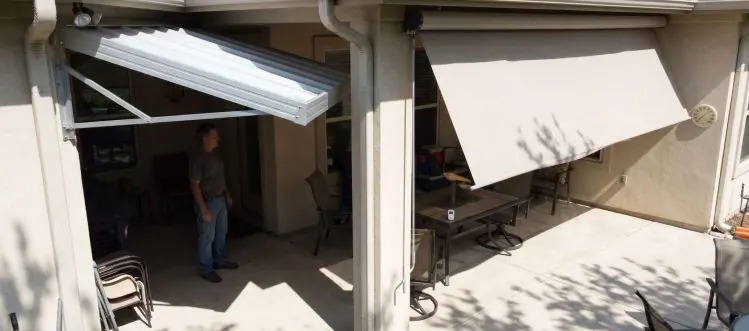
Fixed awnings handle Texas wind zones better than motorized shades. But motorized systems win for insect control and precise sun tracking.
You're standing on your west-facing patio at 3 PM in July, squinting through the glare and feeling the heat radiating off everything around you. The question isn't whether you need shade, it's which type will actually solve your problem without creating new ones. Most homeowners get caught up in the glamour of motorized systems without understanding when a simple fixed awning might serve them better.
The choice between motorized patio shades and fixed awnings isn't just about budget or convenience. It's about understanding how wind loads, fabric tension, sun angles, and maintenance realities play out over years of actual use. You'll discover why some $3,000 fixed awnings outperform $8,000 motorized systems, and when that equation flips completely around.
Key Takeaways
- Wind Resistance Reality: Fixed awnings handle sustained winds up to 75 mph while most motorized shades retract automatically at 25-35 mph, making them less reliable during storms.
- Total Cost Analysis: Factor in motor replacements every 7-12 years, annual maintenance, and electrical work when comparing upfront costs between systems.
- Fabric Performance: Motorized systems use lighter fabrics that wear faster, while fixed awnings use heavier materials that last 15+ years with proper care.
- Sun Angle Optimization: Motorized shades adjust throughout the day for maximum coverage, while fixed awnings only work effectively during specific sun positions.
- Installation Complexity: Fixed awnings require structural mounting and proper pitch for water runoff, while motorized systems need electrical integration and precise alignment for smooth operation.
Why Fixed Awnings Actually Win in Texas Wind Zones 3 and 4
Most homeowners assume motorized means better, but ASCE 7 wind load standards tell a different story. Fixed awnings in Texas wind zones 3 and 4 are engineered to withstand sustained winds of 70-75 mph, while motorized patio shades typically retract automatically when sensors detect winds above 25-35 mph. That's not a design flaw, it's a safety feature that reveals the fundamental difference between these systems.
The structural reality is that fixed awnings use heavy-duty aluminum frames with permanent mounting systems designed to transfer wind loads directly to your home's structure. Motorized shades, by contrast, rely on tensioned cables or tracks that can't handle the same lateral forces. When a sudden thunderstorm hits Austin with 50 mph gusts, your fixed awning stays deployed while your motorized shade retracts, leaving you without protection exactly when you need it most.
Here's how wind resistance compares between fixed awnings and motorized shades across different weather conditions:
| Wind Condition | Fixed Awnings | Motorized Shades |
|---|---|---|
| Normal Operation | Up to 25 mph | Up to 25 mph |
| Storm Conditions | Up to 75 mph | Auto-retract at 25-35 mph |
| Sudden Gusts | Designed to flex and recover | Sensors trigger immediate retraction |
| Sustained High Winds | Engineered for zone compliance | Must remain retracted for safety |
Structural Advantages
- Permanent Mounting: Ledger brackets and through-bolts create a connection that's engineered to handle the full wind load without failure or movement.
- Frame Rigidity: Extruded aluminum frames with welded joints distribute wind forces across the entire structure rather than concentrating stress at pivot points.
- No Moving Parts: Fixed systems eliminate the mechanical failure points that make motorized shades vulnerable during high-wind events and storms.
- Code Compliance: Most fixed awnings meet International Building Code requirements for permanent structures without requiring special wind sensors or automatic retraction systems.
- Emergency Protection: When severe weather hits unexpectedly, fixed awnings continue providing shelter while motorized systems leave you exposed during retraction cycles.
The wind resistance advantage goes beyond just numbers on a spec sheet. In practice, you'll find that fixed awnings provide consistent protection throughout Texas storm season, while motorized shades become fair-weather accessories. That reliability matters when you're planning outdoor events or simply want to keep your patio furniture protected during sudden weather changes.
The Motorized Shade Warranty Trap Most Homeowners Miss
Here's what the sales brochure won't tell you about motorized shade warranties: they're typically segmented between fabric, motor, electronics, and installation, with different terms and exclusions for each component. While Somfy motors might carry a 5-year warranty, the fabric could be limited to 2 years, and the electronic controls might only be covered for 1 year. Meanwhile, that 'lifetime' frame warranty often excludes the very components most likely to fail.
The real trap lies in what's not covered. Wind damage voids most motorized shade warranties, even when the system is operating within its specified limits. UV degradation, normal wear on moving parts, and any damage from power surges or electrical issues typically fall outside warranty coverage. Compare this to fixed awning warranties that usually cover the entire system under a single policy, with fewer exclusions and clearer coverage terms.
Coverage Gaps
- Component Segmentation: Different warranty periods for fabric, motors, electronics, and frames mean you'll likely face out-of-pocket costs for some components while others remain covered.
- Weather Exclusions: Most motorized shade warranties exclude wind damage, UV degradation, and storm-related failures, despite these being the most common causes of problems.
- Electrical Complications: Power surge damage, improper electrical installation, and control system failures often void warranties even when the motor itself remains functional.
- Labor Limitations: Many warranties cover parts but not labor costs, leaving you responsible for service calls, diagnostic fees, and installation charges for replacement components.
- Prorated Coverage: Fabric warranties often use prorated coverage that reduces reimbursement based on age, meaning a 3-year-old fabric might only receive 40% coverage for replacement.
The warranty complexity isn't necessarily a deal-breaker, but it's essential to understand what you're actually protected against. Fixed awnings typically offer simpler warranty terms with broader coverage, while motorized systems require careful documentation and maintenance records to maintain coverage. Factor these potential out-of-pocket costs into your total ownership calculation.
How Fabric Tension Changes Everything About Your Choice
Fabric tension is where the fundamental engineering differences between fixed awnings and motorized shades become most apparent. Fixed awnings use static tension systems that maintain consistent fabric tautness regardless of weather conditions, while motorized shades rely on dynamic tension that changes as the fabric extends and retracts. This difference affects everything from wind resistance to fabric longevity to visual appearance.
The tension requirements also dictate fabric weight and weave patterns. Fixed awnings can use heavy-duty fabrics weighing 12-16 ounces per square yard because the tension system doesn't need to roll or fold the material. Motorized shades typically max out at 8-10 ounce fabrics to ensure smooth operation, which means they're inherently less durable and more susceptible to stretching, tearing, and UV degradation over time.
Tension Systems
- Static vs Dynamic: Fixed awnings maintain constant tension through spring-loaded arms or cable systems, while motorized shades experience varying tension throughout their operating cycle.
- Fabric Weight Limits: Motorized systems require lighter fabrics for smooth operation, typically limiting options to 8-10 oz materials compared to 12-16 oz fabrics used in fixed awnings.
- Wind Response: Properly tensioned fixed awnings flex and recover from wind gusts, while loose motorized shade fabrics can flap, stretch, or develop permanent deformation under stress.
- Maintenance Requirements: Motorized systems need periodic tension adjustments as fabrics stretch over time, while fixed awnings maintain their initial tension settings for years without adjustment.
- Visual Impact: Sagging or improperly tensioned motorized shades create an unkempt appearance, while fixed awnings maintain their crisp, taut appearance throughout their lifespan.
The tension factor often gets overlooked during initial comparisons, but it becomes increasingly important as systems age. A fixed awning that looks crisp and professional after five years can make a motorized shade with stretched fabric look shabby by comparison. Consider how important long-term appearance is for your specific installation location.
When a $3,000 Fixed Awning Outperforms a $8,000 Motorized System
The performance gap becomes obvious in specific scenarios that many homeowners don't consider during the selection process. A well-designed fixed awning over a south-facing patio provides consistent shade from 10 AM to 4 PM during summer months, while a motorized shade might only be effective for 6-8 hours due to sun angle limitations and operational restrictions. When you factor in the reliability difference, the lower-cost fixed system often delivers better actual shade hours per dollar invested.
The $5,000 price difference isn't just about initial cost, it's about functional value over time. That $3,000 fixed awning includes heavy-duty fabrics, permanent mounting hardware, and a simple mechanical system with minimal maintenance needs. The $8,000 motorized system includes motors, controls, sensors, electrical integration, and ongoing maintenance requirements that can add thousands more over its lifespan.
Value Scenarios
- Consistent Coverage: Fixed awnings provide reliable shade during peak sun hours without depending on sensors, power, or mechanical systems that might fail during critical periods.
- Maintenance Simplicity: Annual cleaning and periodic hardware inspection versus motor servicing, sensor calibration, and electronic component replacement creates significant cost differences over time.
- Weather Reliability: Fixed awnings continue functioning during power outages, storms, and equipment failures when you most need protection from the elements.
- Installation Permanence: Once properly installed, fixed awnings require no ongoing adjustments, programming, or system updates compared to motorized systems that need periodic recalibration.
- Resale Value: Well-maintained fixed awnings are viewed as permanent improvements, while aging motorized systems with outdated controls may actually detract from property value.
The performance advantage of fixed awnings becomes most apparent during the second and third years of ownership, when motorized systems start requiring maintenance while fixed awnings continue operating without intervention. If your primary goal is reliable, low-maintenance shade coverage, the simpler system often proves more valuable regardless of the initial price difference.
The Sun Angle Problem That Kills Motorized Shade ROI
Most motorized shade installations fail to account for seasonal sun angle changes that dramatically affect system effectiveness throughout the year. A motorized shade positioned for optimal summer performance might provide minimal benefit during spring and fall when the sun tracks at different angles. Fixed awnings, while less adjustable, can be designed with specific projections and angles that optimize performance for the most critical months of the year.
The ROI killer is that motorized shades often get installed based on peak summer conditions without considering year-round utility. A system that provides excellent coverage in July might be nearly useless in March and October when you still want outdoor comfort. Fixed awnings, properly designed for your specific orientation and climate, can provide valuable shade for 8-9 months per year versus 4-5 months for poorly planned motorized systems.
Angle Optimization
- Seasonal Variation: Sun angles change 47 degrees between summer and winter solstices, dramatically affecting shade effectiveness for both systems throughout the year.
- Fixed Optimization: Properly designed fixed awnings can be angled and sized to provide maximum benefit during the hottest months when cooling costs are highest.
- Motorized Limitations: Despite their adjustability, motorized shades are typically installed in fixed positions and don't actually adjust for seasonal sun angle changes.
- Coverage Efficiency: A well-designed fixed awning might provide 80% optimal coverage for 8 months versus a motorized system providing 95% coverage for only 4 months.
- Energy Impact: The longer seasonal effectiveness of properly designed fixed awnings often results in greater annual energy savings despite lower peak performance ratings.
The sun angle consideration reveals why professional design matters more than automation features. A fixed awning designed by someone who understands solar geometry for your specific location often outperforms a motorized system that was simply installed without proper angle analysis. Consider your year-round comfort needs, not just peak summer performance.
Why Professional Installers Push Back on Certain Motorized Requests
Experienced installers often discourage motorized shade installations in specific situations, not because they want to sell cheaper alternatives, but because they've seen too many callbacks and warranty claims from problematic installations. Homes with complex rooflines, limited electrical access, or exposure to high winds create installation challenges that significantly increase failure rates for motorized systems. Smart installers would rather recommend a fixed awning that will perform reliably than deal with ongoing service issues.
The pushback usually centers on three main concerns: electrical complexity, structural limitations, and environmental exposure. Running new electrical circuits to outdoor locations, dealing with insufficient mounting surfaces, and installing systems that will face severe weather conditions all increase the likelihood of problems that reflect poorly on the installer's reputation, regardless of whether the issues stem from design limitations or installation quality.
Installation Concerns
- Electrical Challenges: Running GFCI-protected circuits to outdoor locations, dealing with existing electrical panel capacity, and ensuring NEC compliance adds complexity and potential failure points.
- Structural Limitations: Insufficient mounting surfaces, hollow walls, or inadequate load-bearing capacity make motorized installations risky compared to simpler fixed awning mounting requirements.
- Weather Exposure: Locations with high wind exposure, frequent storms, or extreme temperature variations create harsh operating conditions that increase motorized system failure rates.
- Access Issues: Difficult-to-reach installations make ongoing maintenance and repairs problematic, leading to higher service costs and customer dissatisfaction over time.
- Warranty Liability: Complex installations with multiple potential failure points create warranty claim risks that experienced installers prefer to avoid through simpler, more reliable alternatives.
When a professional installer suggests a fixed awning over a motorized system, they're usually drawing on experience with similar installations and environmental conditions. Their pushback isn't about limiting your options, it's about ensuring you get a system that will actually work reliably in your specific situation.
The Maintenance Reality Check After Year Three
The true cost difference between motorized shades and fixed awnings becomes apparent around year three, when motorized systems typically need their first major maintenance while fixed awnings are just hitting their stride. Motorized shade owners start dealing with motor recalibration, sensor cleaning, fabric adjustments, and electronic component issues that can cost $300-800 per service call. Meanwhile, fixed awning maintenance usually involves annual cleaning and periodic hardware inspection at a fraction of the cost.
By year five, the maintenance gap widens significantly. Motorized systems often need motor replacement, control system updates, or major fabric repairs that can cost $1,500-3,000. Fixed awnings might need fabric cleaning and minor hardware adjustments totaling $200-400. The cumulative maintenance costs can actually exceed the initial price difference between the systems, fundamentally changing the value equation.
Here's how maintenance costs typically accumulate over the first five years for each system type:
| Year | Motorized Shades | Fixed Awnings |
|---|---|---|
| Year 1 | $0-200 (warranty period) | $0-100 (minor adjustments) |
| Year 2 | $200-400 (calibration) | $50-150 (cleaning) |
| Year 3 | $400-800 (motor service) | $100-200 (hardware check) |
| Year 4 | $600-1200 (fabric/electronics) | $150-300 (deep cleaning) |
| Year 5 | $1000-2500 (major repairs) | $200-400 (fabric treatment) |
Maintenance Realities
- Component Complexity: Multiple moving parts, electronic controls, and sensors create numerous potential failure points that require specialized service and replacement parts.
- Seasonal Preparation: Motorized systems need pre-season calibration and post-season storage procedures, while fixed awnings operate year-round without seasonal maintenance requirements.
- Professional Service: Most motorized shade repairs require factory-trained technicians with specialized tools, while fixed awning maintenance can often be handled by general contractors or handymen.
- Parts Availability: Motorized system components may become obsolete or require special ordering, while fixed awning parts are generally standardized and readily available.
- DIY Limitations: Homeowners can perform most fixed awning maintenance tasks themselves, while motorized systems require professional service for anything beyond basic cleaning.
The maintenance reality often surprises homeowners who assumed motorized meant maintenance-free. While the automation is convenient, it comes with ongoing service requirements that fixed awnings simply don't have. Factor these long-term costs into your decision, especially if you prefer low-maintenance outdoor improvements.
Making Your Shade Decision
The choice between motorized patio shades and fixed awnings ultimately depends on your priorities: convenience versus reliability, automation versus simplicity, and ongoing costs versus upfront investment. If you value consistent performance, minimal maintenance, and maximum wind resistance, fixed awnings deliver proven results at lower total cost. If you prioritize adjustability, insect control, and high-tech convenience, motorized shades offer features that fixed systems simply can't match.
Both systems can provide excellent shade and energy savings when properly selected and installed for your specific situation. The key is understanding your local climate conditions, maintenance preferences, and long-term performance expectations before making your investment. Whether you choose the reliability of a fixed awning or the versatility of a motorized system, proper professional installation and realistic maintenance planning will determine your satisfaction with the results.
Author
Lane Frazier brings two decades of hands-on experience installing custom motorized shades and fixed awnings across Central Texas, from Austin's urban patios to lakefront properties in Horseshoe Bay. His perspective on system reliability and long-term performance comes from countless service calls and warranty claims that reveal how these systems actually perform in Texas heat, wind, and storms. Lane's practical approach helps homeowners cut through marketing claims to understand which shade solution will truly work for their specific situation and maintenance preferences.
Ready For a Quote?
Get your custom shade quote Today.
Free, no-pressure consultation. We measure, photograph, and send a written line-item proposal within a week. Most installs ship in 3–5 weeks.
Call the workshop
(512) 939-3446
Mon–Fri · 8a–5p CT · Austin, TX
Prefer to talk it through? Calls are answered by the same team that builds your quote — no call centers, no gatekeepers.
Custom exterior shades, motorized patio screens, awnings, and interior window treatments for Austin and Central Texas.
How To Contact Us
Austin, TX 78734
Monday - Friday 8 AM - 5 PM
navigate
Copyright © 2026 | Treaty Oak Shade Co. All Rights Reserved. | Privacy Policy