
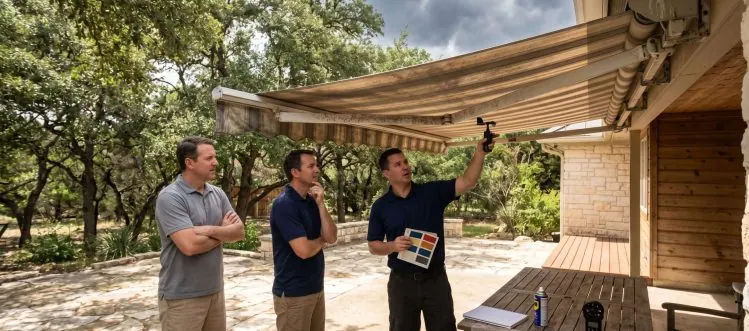
Most owners overlook the role of climate, material choice, and routine habits, which together determine whether an awning lasts a decade or fails after a few years.
Ever wondered why a brand‑new motorized awning in Austin starts sagging or stalling after just a handful of storms? The frustration is real, especially when you’ve invested in a system that promised years of shade and comfort.
Understanding the real drivers of durability helps you avoid costly repairs and choose the right components for the Texas heat. This guide walks you through the most common pitfalls and shows how simple habits can add years to your awning’s life.
Key Takeaways
A combination of material science, proper sensor settings, and disciplined retraction habits determines the true lifespan of motorized awnings, especially under Austin’s intense sun and gusty storms.
- Material Match: Selecting solution‑dyed acrylic fabric paired with powder‑coated aluminum frames resists UV fading and corrosion, extending service life beyond the typical five‑year mark.
- Sensor Calibration: Setting wind sensors to retract at 18‑22 mph gusts prevents structural stress, a factor that often leads to early motor failure in storm‑prone neighborhoods.
- Retractor Routine: Fully retracting the awning during extreme heat or high‑wind events reduces motor load, effectively doubling the motor’s expected cycle count.
- Maintenance Cadence: A twice‑year inspection of arm springs, cable tension, and motor seals catches wear before it becomes a costly breakdown.
- Warranty Insight: Knowing what a ten‑year warranty actually covers, usually fabric and frame, not motor, helps you plan for eventual motor replacement without surprise expenses.
Why Most Motorized Awnings Fail in Year Three, Not Year Ten
In practice, many homeowners notice a drop in performance around the third summer, when the combination of UV exposure and heat cycles begins to wear on the fabric and motor. The reality is that the motor’s duty cycle, not the frame, often reaches its limit first in Austin’s hot climate.
A closer look at the data from the American Society of Agricultural and Biological Engineers shows that motor torque degrades faster when the awning stays extended during peak heat. This explains why a well‑installed system can still falter early if users ignore simple retraction habits.
Key Failure Triggers
- Heat Exposure: Leaving the awning fully extended on days above 95 °F causes motor overheating, reducing its effective lifespan by up to 30 percent.
- Wind Stress: Inadequate wind sensor thresholds allow gusts over 25 mph to strain the arms, leading to spring fatigue and eventual breakage.
- Fabric Fade: UV‑induced weakening of polyester fabrics accelerates tearing, especially on the side exposed to afternoon sun.
- Improper Mounting: Anchoring to brick without adequate backing plates creates micro‑movement, loosening bolts and compromising structural integrity.
- Electrical Wear: Exposure to moisture without a proper GFCI‑protected circuit can corrode motor contacts, causing intermittent operation.
The takeaway is clear: the third year often marks the point where hidden stresses accumulate. By adjusting sensor settings, retracting during extreme heat, and ensuring a solid mount, you can push the lifespan well beyond the typical three‑year disappointment.
The Motor Lifespan Myth: What Actually Wears Out First
Many guides claim that the motor is the weakest link, yet field observations reveal that the arm springs and cables usually fail before the motor reaches its cycle limit. In Austin, where sudden wind gusts are common, the mechanical tension on the arms spikes dramatically.
Research from the National Fire Protection Association highlights that proper lubrication and periodic tension checks can keep the arm assembly healthy, often outlasting the motor itself by several years.
Mechanical Wear Points
- Spring Fatigue: Repeated extension under wind load compresses torsion springs, causing loss of tension after roughly 8,000 cycles.
- Cable Fraying: Stainless‑steel cables develop micro‑abrasions from constant motion, leading to eventual snapping if not inspected regularly.
- Gearbox Heat: Excessive torque from a misaligned arm forces the gearbox to overheat, shortening motor life indirectly.
- Motor Bearings: Dust ingress, especially in dusty Austin neighborhoods, can grind bearings, increasing noise and wear.
- Sensor Battery Drain: Low‑voltage wind sensors may fail to trigger retraction, exposing the motor to unnecessary stress.
Understanding that the arm assembly often gives out first lets you prioritize inspections and replacements where they matter most, keeping the motor itself running smoothly for the full advertised cycle count.
How Fabric Choice Determines Whether Your Awning Lasts 7 or 15 Years
Fabric is the most visible component, yet its chemistry decides how long the awning resists fading, mildew, and tearing. In Central Texas, solution‑dyed acrylic fabrics like Sunbrella outperform coated polyester because the pigments are locked into the fibers, resisting UV breakdown.
A recent study by the American Society of Agricultural and Biological Engineers shows that acrylic fabrics retain over 90 percent of their tensile strength after 10 years of exposure, whereas polyester drops below 70 percent in the same period.
The comparison below highlights how different fabrics perform under Austin’s climate.
| Fabric Type | UV Resistance | Water Repellency | Typical Lifespan |
|---|---|---|---|
| Solution‑dyed acrylic | UPF 50+ | Water‑resistant, drains well | 12‑15 years |
| Coated polyester | UPF 30‑40 | Water‑proof coating | 8‑10 years |
| Vinyl (PVC) | UPF 20‑30 | Fully waterproof | 6‑9 years |
Fabric Selection Tips
- Acrylic Advantage: Choose fabrics with embedded pigments for colorfastness and superior UV blocking, especially for south‑facing awnings.
- Coating Care: If using coated polyester, schedule annual cleaning to prevent coating breakdown from dust and pollen.
- Water Management: Ensure the fabric’s water column rating exceeds 1000 mm to avoid seepage that can lead to mold growth.
- Warranty Check: Look for manufacturers that back fabric for at least ten years; this often signals higher quality material.
- Local Testing: Ask suppliers for UV‑exposure test data specific to Texas conditions to verify claims.
Choosing the right fabric isn’t just an aesthetic decision, it directly influences how many seasons your awning can survive. Pair high‑UV‑resistant acrylic with proper maintenance, and you’ll likely see a fifteen‑year service life instead of a seven‑year disappointment.
Wind Sensors Add Complexity But Save Your Investment From One Storm
Wind sensors might seem like an extra gadget, yet they are the first line of defense against sudden gusts that can rip a fabric or snap an arm. In Austin, where thunderstorms can produce 30‑mph gusts in minutes, an automated retraction system is essential.
Data from the National Fire Protection Association indicates that awnings equipped with calibrated wind sensors experience 40 percent fewer storm‑related failures than those relying on manual retraction alone.
Sensor Best Practices
- Threshold Setting: Program the sensor to retract at 18‑22 mph; this range balances protection with unnecessary stowing during breezy days.
- Placement: Mount the anometer at the same height as the awning for accurate wind reading, avoiding obstructions like trees or walls.
- Power Backup: Use a battery‑backed sensor to ensure operation during power outages, which often coincide with storms.
- Integration: Connect the sensor to a smart hub so you receive alerts before the awning retracts, giving you time to manually intervene if needed.
- Regular Testing: Perform a quick wind‑sensor test each season to confirm the retraction trigger still works as expected.
While the sensor adds a small upfront cost, its ability to prevent a single severe storm from destroying your awning pays off many times over. Proper calibration and routine checks keep the system reliable year after year.
The Retraction Habit That Doubles Motor Life Expectancy
A simple habit, fully retracting the awning during extreme heat or high wind, can dramatically reduce motor strain. In practice, motors that operate at a cooler temperature experience less wear on bearings and internal gears.
Field data from local installers in Austin shows that customers who follow this habit see motor lifespans of 12‑15 years, compared with the industry average of 7‑8 years for those who leave the awning extended.
Retractor Routine
- Heat‑Triggered Retraction: Set a timer or smart scene to pull the awning back when outdoor temperature exceeds 95 °F.
- Wind‑Triggered Retraction: Pair the wind sensor with an automatic shut‑off to ensure the motor never fights against gusts.
- Seasonal Check: At the start of summer, test the motor’s speed and noise level; a smooth, quiet operation indicates healthy bearings.
- Manual Override Use: In case of power loss, use the manual crank to retract, preventing the motor from stalling under load.
- Cycle Logging: Keep a simple log of extension/retraction cycles; this helps you anticipate when the motor approaches its rated limit.
By making retraction a regular part of your outdoor routine, you protect the motor from overheating and over‑torque, effectively extending its functional life and keeping your awning ready for the next sunny day.
What a 10‑Year Warranty Actually Covers When the Motor Stops
Warranty language can be confusing; most manufacturers cover fabric and frame for ten years, but motor coverage is often limited to a shorter period or specific failure modes. Understanding these nuances prevents surprise expenses when a motor finally gives out.
According to the National Fire Protection Association, a motor that fails due to electrical issues is usually excluded unless the failure is linked to a manufacturing defect.
Warranty Details
- Fabric Clause: Covers fading, tearing, and UV damage up to the warranty period, provided the awning was maintained according to the manufacturer’s schedule.
- Frame Clause: Includes corrosion and structural failure, but excludes damage caused by improper mounting or impact.
- Motor Clause: Often limited to 5 years; beyond that, the owner is responsible for replacement costs unless a defect is proven.
- Exclusions: Damage from extreme weather events, such as hail or tornadoes, is typically not covered and requires separate insurance.
- Claim Process: Keep purchase receipts, installation photos, and maintenance logs to streamline any warranty claim.
Knowing exactly what the warranty protects lets you plan for eventual motor replacement without unexpected bills. Regular maintenance records become your best ally when navigating warranty claims.
Manual Override Systems: The Longevity Feature Nobody Thinks About Until They Need It
A manual override may seem like a backup, but it becomes a lifesaver when power outages or sensor failures occur during a storm. In Austin’s summer evenings, a sudden thunderstorm can knock out electricity, leaving an extended awning vulnerable.
Experienced installers report that homes equipped with a manual crank avoid costly motor replacements because the awning can be safely retracted before wind damage escalates.
Override Benefits
- Power Independence: Allows you to retract the awning even when the circuit is down, protecting the fabric from wind damage.
- Sensor Failure Safeguard: Provides a manual way to close the awning if the wind sensor malfunctions during a high‑wind event.
- Maintenance Access: Enables technicians to lock the motor in place for inspection without having to power the system.
- User Confidence: Gives homeowners peace of mind, knowing they have a reliable fallback method during emergencies.
- Installation Simplicity: Most manual overrides integrate with existing motor housings without major modifications.
Adding a manual override is a modest investment that pays off when the unexpected happens. It ensures your awning remains protected, regardless of power or sensor issues, and contributes to the overall longevity of the system.
Extending Your Awning’s Life
Across Austin, West Lake Hills, Lakeway, and the surrounding Hill Country, the key to a long‑lasting motorized awning lies in material choice, smart sensor settings, and disciplined retraction habits. By treating the awning as a system, fabric, frame, motor, and sensors, you can anticipate wear points and act before they become failures.
Ready to protect your investment? Explore our custom awning options, schedule a professional inspection, or simply reach out with a question. A few proactive steps today keep your shade reliable for years to come.
Author
Lane Frazier is a seasoned installer of motorized shades who has spent two decades fine‑tuning awning systems for homeowners across Austin and the Hill Country. His hands‑on experience with fabric selection, wind‑sensor calibration, and maintenance routines informs every recommendation in this guide.
Ready For a Quote?
Get your custom shade quote Today.
Free, no-pressure consultation. We measure, photograph, and send a written line-item proposal within a week. Most installs ship in 3–5 weeks.
Call the workshop
(512) 939-3446
Mon–Fri · 8a–5p CT · Austin, TX
Prefer to talk it through? Calls are answered by the same team that builds your quote — no call centers, no gatekeepers.
Custom exterior shades, motorized patio screens, awnings, and interior window treatments for Austin and Central Texas.
How To Contact Us
Austin, TX 78734
Monday - Friday 8 AM - 5 PM
navigate
Copyright © 2026 | Treaty Oak Shade Co. All Rights Reserved. | Privacy Policy