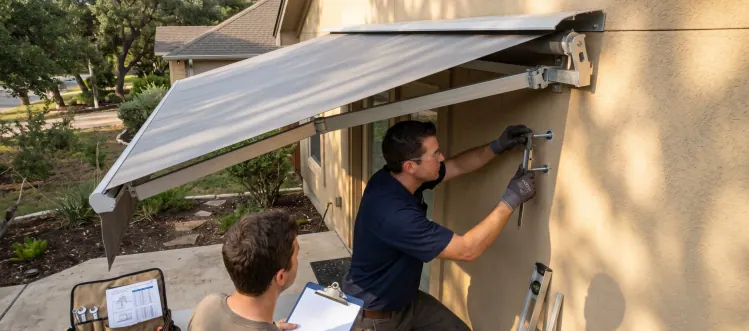
Understanding wind loads and proper anchoring prevents costly failures, while local code knowledge ensures safe, reliable operation for motorized awnings.
Ever watched a motorized awning snap back during a gust and wondered why the frame stayed intact but the fabric tore? That moment reveals a hidden flaw many homeowners overlook when they focus only on the motor or fabric choice.
The real secret lies in how the awning is attached and how it reacts to wind, rain, and temperature swings across Austin, West Lake Hills, and surrounding Hill Country towns. This guide walks you through the critical steps that keep your shade system sturdy and code‑compliant.
Key Takeaways
Proper wind‑load calculations, deep anchoring, and regular tension checks are the three pillars of lasting structural integrity for motorized awnings in Central Texas.
- Wind Rating Focus: Choose awnings rated for at least 45 mph gusts, then calibrate auto‑retract sensors to 20 mph for a safety margin.
- Mounting Depth: Use through‑bolts or epoxy anchors that embed at least 1.5 inches into studs or masonry, matching the ASCE 7‑16 wind‑load tables.
- Material Match: Pair marine‑grade acrylic fabrics with aluminum frames to balance UV resistance and corrosion protection in Austin’s hot climate.
- Code Checklist: Verify that your installation meets the International Building Code, local Austin amendments, and NEC requirements for motor wiring.
- Maintenance Routine: Inspect fasteners, tension cables, and sensor alignment each spring to catch wear before a storm hits.
Why Wind Load Ratings Matter More Than Frame Material Alone
When a gust hits a patio, the force on the awning is a function of surface area, wind speed, and exposure, not just the metal used for the frame. Engineers calculate this as wind load, a value that directly influences how much tension the brackets must hold. In Austin, summer thunderstorms can push wind speeds past 50 mph, so an awning that only boasts a steel frame may still fail if its wind rating is insufficient.
The real danger appears when the wind rating and the mounting system are mismatched. A lightweight aluminum frame can survive a 30 mph gust if properly anchored, while a heavy steel frame can be ripped away if the fasteners are too short. Understanding the wind‑load concept lets you choose the right combination of fabric, frame, and hardware for your home’s exposure.
Key Wind‑Load Insights
- Load Calculation: Wind pressure rises with the square of speed, so a 40 mph gust exerts four times the force of a 20 mph wind, demanding stronger anchors.
- Rating Sources: Manufacturers publish wind‑class numbers based on AC‑ under, and the Awnings Manufacturers Association validates those claims with field testing.
- Sensor Integration: Modern Somfy motors include built‑in anemometers that trigger retraction at a preset threshold, reducing reliance on manual monitoring.
- Local Climate: Austin’s average summer wind gusts hover around 30 mph, but occasional storms exceed 60 mph, so a safety factor of 1.5 is advisable.
- Exception Note: In shaded courtyards where wind exposure is limited, a lower rating may be acceptable, but verification against the IBC still applies.
By treating wind load as the primary design driver, you can select a frame material that complements the rating, not replaces it. In practice, this means a lightweight aluminum system with a high‑class rating often outperforms a bulky steel unit lacking proper anchoring. The result is a shade solution that stays put during Austin’s most aggressive storms.
The Three Structural Failure Points Most Homeowners Never Inspect
Even a perfectly rated awning can collapse if a single weak link is ignored. Homeowners tend to check the fabric for fading, but the real culprits are hidden behind the wall: the mounting brackets, the fastener depth, and the tension cables. Skipping these inspections leaves the system vulnerable to wind‑induced fatigue.
A quick visual scan often misses subtle signs like cracked epoxy or stretched cables, especially when the awning is retracted. In Austin’s humid climate, corrosion can start inside a steel bolt before any rust is visible on the surface. Regular, detailed checks catch these issues early, preserving both safety and warranty coverage.
Common Inspection Gaps
- Bracket Condition: Look for rust, deformation, or loose bolts; a single compromised bracket can let the whole frame pivot under wind pressure.
- Fastener Depth: Verify that anchors extend at least 1.5 inches into the structural member; shallow embeds lose pull‑out resistance during gusts.
- Cable Tension: Check that stainless‑steel cables maintain firm tension; slack cables cause fabric sag and uneven load distribution.
- Motor Mounting: Ensure the motor housing is bolted to a solid backing plate; vibration can loosen connections over time.
- Exception Note: In masonry walls, using wedge anchors provides better shear capacity than lag screws, but only if the hole is drilled to the correct depth.
A disciplined inspection routine transforms a decorative feature into a reliable structural component. In practice, homeowners who schedule a semi‑annual review avoid surprise failures during Austin’s spring storm season. The effort pays off in peace of mind and protects the investment in high‑quality materials.
How Improper Mounting Depth Compromises Motorized Awning Stability
Mounting depth is the hidden variable that determines whether a bracket can resist the pull of wind‑loaded fabric. When the fastener is too short, the load transfers to the wall surface, which may crack or split under repeated stress. Austin’s stucco and brick exteriors demand precise drilling to achieve the required embedment depth for both concrete and hollow‑wall applications.
The problem becomes more acute with motorized awnings because the retraction force adds a dynamic component to the load. A shallow anchor may hold while the awning is extended, but during rapid retraction the sudden change in tension can pry the fastener loose, leading to a catastrophic detachment.
Depth‑Related Risks
- Embedment Standard: Follow the IBC Table 3105, which recommends a minimum of 1.5 inches of embedment for masonry and 2 inches for concrete when using stainless‑steel bolts.
- Drill Accuracy: Use a calibrated drill and verify hole depth with a depth gauge; over‑drilling can weaken the substrate.
- Fastener Choice: Opt for through‑bolts with washers for wood studs, and epoxy‑set anchors for brick veneer to achieve full shear capacity.
- Seasonal Expansion: Account for thermal expansion of aluminum frames; deeper anchors reduce the risk of loosening as the metal expands in summer heat.
- Exception Note: In historic districts where façade alterations are restricted, a concealed mounting plate can distribute load without altering the original wall finish.
Getting the depth right is a small step that prevents big problems. In practice, a correctly embedded fastener holds steady through Austin’s temperature swings and wind events, keeping the awning securely attached for years. The payoff is a system that operates smoothly without the need for frequent repairs.
What Building Codes Actually Require for Retractable Awning Installation
Many homeowners assume that a decorative awning falls outside building code scope, but the International Building Code treats retractable canopies as special construction. The code references ASCE 7‑16 for wind load calculations and mandates that any electrical wiring for motorized units complies with the National Electrical Code. In Austin, the city adopts the IBC with local amendments that add specific setback and height limits for awnings extending beyond the façade.
Compliance isn’t just paperwork; it ensures that the awning can survive the wind speeds documented by FEMA for the Central Texas region. Failure to meet these standards can void insurance coverage and lead to costly retrofits after a storm.
Code Essentials
- Wind Load Compliance: Design the awning to resist the wind pressure specified in ASCE 7‑16 for your zone, typically 30 psf for Austin’s Category C exposure.
- Electrical Safety: Run motor wiring in conduit and protect it with a GFCI‑protected circuit as required by NEC Article 210.8.
- Permit Requirement: Obtain a building permit for awnings larger than 6 ft² or those that project more than 12 inches from the wall line.
- Setback Rules: Maintain a minimum 3‑foot clearance from property lines in residential districts to avoid encroachment penalties.
- Exception Note: In single‑family homes with a detached garage, a smaller awning may be exempt from a permit, but the wind‑load analysis still applies.
Understanding and following these code requirements protects you from legal and safety pitfalls. In practice, a compliant installation passes inspection the, operates reliably, and retains its warranty. For Austin homeowners, aligning with local amendments ensures the awning fits both the climate and the municipality’s expectations.
When Aluminum Frames Outperform Steel in Structural Performance
Aluminum and steel each have strengths, but in Austin’s hot, humid environment aluminum often provides a better balance of durability and weight. Its natural corrosion resistance means fewer maintenance cycles, while its lighter mass reduces the load on wall anchors. Steel, though stronger in pure tension, can rust if the coating is compromised, leading to hidden failures over time.
The decision hinges on the awning’s size, exposure, and the homeowner’s willingness to perform periodic inspections. For larger projections that experience higher wind pressure, a well‑engineered aluminum frame with a higher wind‑class rating can be more reliable than a steel frame lacking proper corrosion protection.
Aluminum Advantages
- Corrosion Resistance: Aluminum forms a protective oxide layer, preventing rust in Austin’s humid summers without additional coating.
- Weight Savings: A lighter frame reduces the shear force on mounting brackets, allowing smaller anchors while maintaining safety.
- Thermal Expansion: Aluminum expands predictably with temperature, minimizing stress on fasteners during summer heat spikes.
- Fabric Compatibility: Marine‑grade acrylic fabrics bond well with aluminum rollers, ensuring smooth retraction and reduced wear.
- Exception Note: In extremely high‑wind zones, a steel frame with a higher wind‑class rating may be required, but only if corrosion is mitigated with proper powder coating.
Choosing aluminum doesn’t mean sacrificing strength; it means selecting a material that works with Austin’s climate and the awning’s mechanical demands. In practice, homeowners enjoy longer intervals between inspections and a lower risk of rust‑related failures. The result is a shade system that stays functional and attractive for many years.
The Wall Anchor Mistake That Voids Your Warranty and Risks Collapse
Manufacturers often stipulate that only approved anchoring methods maintain warranty coverage. Using generic drywall anchors or shortcuts like adhesive strips may seem convenient, but they cannot resist the dynamic loads of a motorized awning. When a wind event exceeds the anchor’s capacity, the entire system can detach, leading to property damage and a voided warranty.
A common scenario in Austin’s newer homes involves mounting to hollow‑wall studs with cheap toggle bolts. These fasteners may hold the weight of the awning when retracted, but the sudden wind pressure during a storm can pull them out, exposing the wall and compromising the awning’s structural integrity.
Anchor Best Practices
- Approved Fasteners: Use stainless‑steel through‑bolts or epoxy‑set anchors that meet the Awnings Manufacturers Association specifications.
- Load Rating: Select anchors rated for at least 1.5 times the calculated wind load to provide a safety margin.
- Installation Verification: After installing, perform a pull‑test to confirm the anchor holds the required force without movement.
- Warranty Clause: Read the manufacturer’s warranty; many state that improper anchoring nullifies coverage.
- Exception Note: For historic brick façades, a concealed mounting plate can distribute load without altering the original masonry, preserving both warranty and aesthetics.
Avoiding this anchor mistake is a simple yet critical step to keep your awning safe and your warranty intact. In practice, a properly anchored system survives Austin’s gusty spring storms without incident, saving you repair costs and preserving the shade’s lifespan.
How Fabric Tension Affects Long‑Term Structural Integrity of Motorized Systems
Fabric tension is the invisible force that keeps an awning flat, prevents sagging, and distributes wind pressure evenly across the frame. If the tension is too loose, the fabric flutters, creating dynamic loads that can overstress the arms and brackets. Conversely, overtightening can strain the fabric’s seams and cause premature tearing, especially under UV exposure common in Austin’s summer sun.
Modern motorized awnings use spring‑loaded arms and stainless‑steel cables to maintain consistent tension. Regular adjustment is needed because temperature changes cause the fabric to expand and contract, altering the tension set point.
Tension Management Tips
- Initial Setup: Follow the manufacturer’s tension guide, typically measured in pounds of pull on the fabric edge when fully extended.
- Seasonal Check: Re‑tension after winter when the fabric contracts, and after summer when it expands due to heat.
- Cable Inspection: Look for frayed cables or rusted springs; replace any component that shows wear before it fails under load.
- UV Protection: Choose fabrics with a UPF rating of 50+; UV‑stable fibers retain elasticity longer, reducing tension loss over time.
- Exception Note: In shaded courtyards where wind exposure is minimal, slightly lower tension may be acceptable, but always stay within the manufacturer’s recommended range.
Maintaining proper fabric tension is a low‑effort habit that dramatically extends the life of a motorized awning. In practice, homeowners who check tension twice a year avoid fabric tears and uneven load distribution, keeping the system safe and functional throughout Austin’s variable climate.
Securing Your Shade System
A motorized awning that respects wind‑load ratings, uses deep‑set anchors, and maintains fabric tension will stand up to Austin’s fierce storms and scorching summers. By following the inspection routines, code requirements, and material choices outlined above, you protect both your investment and your family’s safety.
Ready to verify that your awning meets these standards? Schedule a professional assessment, review your anchoring plan, and adjust tension before the next storm season arrives. A well‑maintained system offers reliable shade, energy savings, and peace of mind for years to come.
Author
Lane Frazier is an experienced installer of motorized shades and awnings for homeowners throughout Austin and the surrounding Hill Country. His two decades of hands‑on work give him a practical perspective on structural integrity and local building codes, making his guidance both credible and actionable.
Ready For a Quote?
Get your custom shade quote Today.
Free, no-pressure consultation. We measure, photograph, and send a written line-item proposal within a week. Most installs ship in 3–5 weeks.
Call the workshop
(512) 939-3446
Mon–Fri · 8a–5p CT · Austin, TX
Prefer to talk it through? Calls are answered by the same team that builds your quote — no call centers, no gatekeepers.
Custom exterior shades, motorized patio screens, awnings, and interior window treatments for Austin and Central Texas.
How To Contact Us
Austin, TX 78734
Monday - Friday 8 AM - 5 PM
navigate
Copyright © 2026 | Treaty Oak Shade Co. All Rights Reserved. | Privacy Policy