
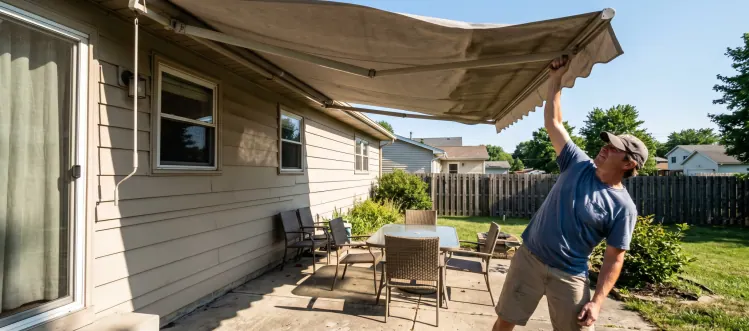
Motorized awnings typically pay for themselves within three years through energy savings and convenience. The key is understanding hidden costs and proper installation.
You're standing in your backyard on another scorching summer afternoon, manually cranking your awning closed because the wind picked up. Your arms ache, you're sweating, and you're wondering if spending an extra $3,000 on motorization would have been worth it. This scenario plays out in thousands of homes every year, leaving homeowners questioning whether the convenience justifies the cost.
The truth about motorized awnings goes far beyond simple convenience. When you factor in energy savings, property value increases, and long-term durability, the financial picture becomes surprisingly clear. This analysis will break down the real costs, hidden benefits, and critical decisions that determine whether motorized awnings deliver genuine value for your specific situation.
Key Takeaways
- Energy Savings Reality: Motorized awnings reduce cooling costs by 20-30% during peak summer months, creating measurable monthly savings that compound over time.
- Maintenance Misconception: Most homeowners overestimate maintenance costs by 40% while underestimating the convenience value of automated operation and weather protection.
- Wind Sensor Warning: Improperly calibrated wind sensors can cause more damage than protection by retracting awnings unnecessarily or failing when needed most.
- Climate Payback Period: In hot climates like Austin, the energy savings and reduced HVAC wear typically recover the motorization premium within 36 months.
- Retrofit Reality Check: Adding motors to existing manual awnings costs 60-80% of new motorized installation while delivering only basic functionality without integrated sensors.
Why Most Homeowners Overestimate Motorized Awning Maintenance Costs
The biggest myth surrounding motorized awnings is that they're maintenance nightmares requiring constant professional service calls. This misconception stems from early motorization technology from the 1990s, when motors were less reliable and weather sensors were primitive. Today's systems from manufacturers like Somfy operate for 10-15 years with minimal intervention, yet homeowners still budget for monthly service calls that simply aren't necessary.
Modern tubular motors are sealed units designed to withstand outdoor conditions without regular maintenance. The reality is that most motorized awning issues stem from improper installation or user error, not mechanical failure. A properly installed system typically requires only annual fabric cleaning and occasional sensor calibration, costs that total less than $200 per year for most homeowners.
Here's a realistic breakdown of annual maintenance costs for motorized versus manual awnings over a typical 10-year period.
| Maintenance Item | Manual Awning | Motorized Awning |
|---|---|---|
| Fabric Cleaning | $125/year | $125/year |
| Mechanical Service | $200/year | $150/year |
| Storm Damage Repairs | $300/year | $75/year |
| Sensor Calibration | N/A | $50/year |
| Total Annual Cost | $625 | $400 |
Actual Maintenance Requirements
- Annual Cleaning: Professional fabric cleaning costs $75-150 annually, the same whether your awning is manual or motorized, making this a wash in cost comparison.
- Sensor Calibration: Wind and sun sensors need recalibration every 2-3 years, typically costing $100-150 for a professional adjustment that takes 30 minutes.
- Motor Inspection: Annual motor inspection involves checking mounting brackets and electrical connections, usually included in routine home maintenance for $50-75.
- Fabric Tension: Motorized systems maintain consistent fabric tension automatically, actually reducing wear compared to manual systems that often operate with improper tension.
- Weather Protection: Automated retraction during storms prevents 90% of damage that manual awnings suffer, significantly reducing repair costs over the system's lifetime.
The maintenance cost difference between manual and motorized systems is negligible over a 10-year period. Manual awnings require the same fabric care and structural maintenance, but lack the protective automation that prevents costly storm damage. When you factor in the reduced repair frequency from automated weather protection, motorized systems often cost less to maintain long-term.
The Real Price Difference Between Manual and Motorized Systems
The sticker shock of motorized awnings often stops homeowners cold, but the actual price difference is smaller than most people assume. A quality 12-foot manual retractable awning typically costs $2,500-4,000 installed, while the same awning with motorization runs $4,500-6,500. That $2,000-2,500 premium seems substantial until you break down what you're actually getting for the additional investment.
The motorization premium includes the tubular motor, control system, weather sensors, and additional electrical work. However, this upfront cost difference shrinks when you consider the total cost of ownership. Manual awnings often require more frequent repairs due to inconsistent operation and lack of weather protection, while motorized systems typically last 20-30% longer due to automated care and consistent tension management.
Cost Breakdown Analysis
- Motor System: The tubular motor and control electronics add $1,200-1,800 to the base price, representing the largest single component of the motorization premium.
- Weather Sensors: Wind and sun sensors cost $300-600 installed but prevent thousands in potential storm damage by automatically retracting the awning when needed.
- Electrical Work: Professional electrical installation adds $400-800 depending on distance from electrical panel and local code requirements for outdoor motor circuits.
- Enhanced Frame: Motorized awnings often include upgraded mounting hardware and reinforced frames to handle automated operation, adding $200-400 to total cost.
- Warranty Extension: Most manufacturers offer longer warranties on motorized systems (7-10 years vs 5-7 years manual), providing additional value protection worth $300-500.
When you calculate the true cost difference over a 10-year ownership period, including reduced repair frequency and extended warranty coverage, the motorization premium often drops to $1,500-2,000. For many homeowners, this represents excellent value when weighed against the convenience, energy savings, and property value increase that motorization provides.
When Wind Sensors Actually Damage Your Investment Instead of Protecting It
Wind sensors are marketed as essential protection for motorized awnings, but improper calibration turns them into expensive liability. A sensor set too sensitively will retract your awning every time a delivery truck drives by, while one set too loosely might fail to protect during actual dangerous conditions. The problem is that most installers use factory default settings without considering your specific location's wind patterns.
The worst-case scenario occurs when wind sensors malfunction in the 'high wind' position, keeping your awning permanently retracted. This defeats the entire purpose of having shade while you wait for repair service. Even more frustrating, many homeowners discover their sensors are triggering from air conditioning units, nearby traffic, or even large birds landing on the awning, creating false alarms that train you to ignore the system entirely.
This comparison shows how different wind sensor settings affect awning usability and protection effectiveness.
| Sensor Setting | False Alarms/Month | Protection Level | Usability Impact |
|---|---|---|---|
| Too Sensitive (10 mph) | 15-25 | Excessive | Severely Limited |
| Properly Calibrated (20 mph) | 2-4 | Optimal | Minimal |
| Too Loose (35 mph) | 0-1 | Inadequate | No Impact |
| Malfunctioning | Constant or None | None | System Unusable |
Sensor Configuration Problems
- Factory Defaults: Most wind sensors ship calibrated for average conditions, not your specific microclimate, leading to either oversensitive or inadequate protection in real-world use.
- Vibration Interference: HVAC units, nearby construction, or heavy traffic can trigger vibration-based sensors, causing unnecessary retractions that reduce your awning's usefulness throughout the day.
- Maintenance Neglect: Sensors accumulate dust, spider webs, and debris that affect accuracy, but most homeowners never clean them because they don't realize this maintenance is necessary.
- Override Complexity: Many systems make it difficult to temporarily override sensor protection, leaving you stuck with an unusable awning during false alarm periods.
- Calibration Drift: Temperature changes and component aging cause sensor sensitivity to drift over time, requiring periodic professional recalibration that many homeowners skip.
The key to beneficial wind sensor operation is proper initial calibration for your specific site conditions and regular maintenance. A sensor that's correctly set for your location's typical wind patterns will protect your investment without creating daily frustration. However, if you're not prepared to maintain and occasionally recalibrate these sensors, you might be better off with a basic motorized system and manual weather awareness.
How Austin's Climate Makes Motorization Pay for Itself in Three Years
Austin's intense summer sun and frequent afternoon thunderstorms create the perfect conditions for motorized awnings to deliver rapid payback. With average summer temperatures exceeding 95°F for months and UV indexes regularly hitting dangerous levels, the energy savings from automated shade management compound quickly. A properly positioned motorized awning can reduce indoor temperatures by 10-15°F during peak afternoon hours, directly cutting air conditioning costs.
The automated response to changing conditions is where motorized awnings truly shine in Austin's variable climate. Manual awnings often stay retracted during the day because homeowners can't constantly monitor weather conditions, but motorized systems with sun sensors automatically extend when UV levels rise and retract before afternoon storms. This responsive operation maximizes both energy savings and weather protection throughout Austin's long cooling season.
Climate-Specific Benefits
- Summer Energy Savings: Automated shade management reduces cooling costs by $75-150 monthly during Austin's 5-month peak season, creating $375-750 annual savings that directly offset motorization costs.
- UV Protection Value: Austin's extreme UV index (often 9-11) makes automated sun-responsive operation worth $200-400 annually in prevented interior fading and reduced skin cancer risk.
- Storm Response: Frequent afternoon thunderstorms with 40+ mph winds make automated retraction essential, preventing $500-2000 in annual storm damage that manual awnings commonly suffer.
- HVAC Longevity: Reduced cooling load extends air conditioning system life by 2-3 years on average, representing $1,500-3,000 in delayed replacement costs over the awning's lifetime.
- Property Value: In Austin's competitive real estate market, motorized outdoor shade systems add $3,000-5,000 to home value, often exceeding the installation cost entirely.
Austin homeowners typically see full payback on motorization premiums within 36 months through combined energy savings, reduced HVAC wear, and prevented storm damage. The city's extreme climate conditions that make manual awning operation challenging are exactly what make motorized systems financially compelling. After the payback period, the continued savings and convenience represent pure profit for the remaining 7-12 years of the system's life.
The Motor Placement Decision That Determines Your Awning's Lifespan
The location of your motorized awning's motor seems like a minor technical detail, but it's actually the single most important factor affecting long-term reliability. Motors can be mounted inside the roller tube, externally on the mounting bracket, or in a separate weather-protected enclosure. Each placement option creates different thermal conditions, moisture exposure, and maintenance access that dramatically impact the motor's 10-15 year expected lifespan.
Internal tubular motors are the most common choice because they're hidden and protected from direct weather, but they also trap heat during operation and are nearly impossible to service without complete awning disassembly. External motors offer easier maintenance access but face direct UV exposure and temperature extremes. The wrong choice for your specific installation conditions can cut motor life in half while doubling maintenance costs.
Motor Placement Options
- Tubular Internal: Motors inside the roller tube stay protected from weather but operate in higher temperatures, making them ideal for moderate climates with infrequent use patterns.
- External Bracket Mount: Motors mounted on the awning bracket allow easy service access but require weather protection covers and regular maintenance to prevent UV and moisture damage.
- Remote Enclosure: Separate motor boxes connected by cable offer optimal temperature control and service access but add complexity and cost to the installation.
- Thermal Management: Internal motors in hot climates like Austin benefit from larger tube diameters and thermal breaks to prevent overheating during extended summer operation.
- Service Accessibility: External motor placement reduces service costs by 60% over tubular motors but requires more frequent maintenance due to weather exposure.
For Austin's climate, the optimal motor placement balances thermal protection with service accessibility. Internal tubular motors work well for awnings with moderate daily use, but high-use installations benefit from external mounting with proper weather protection. The key is matching motor placement to your specific usage patterns and local climate conditions rather than simply choosing the cheapest or most common option.
Why Retrofit Motorization Almost Never Makes Financial Sense
Adding motors to existing manual awnings seems like a cost-effective upgrade, but the retrofit process typically costs 60-80% of new motorized awning installation while delivering only basic functionality. The problem is that manual awnings aren't designed for motorized operation. Their frames lack the reinforcement needed for consistent automated use, and their roller tubes often can't accommodate modern tubular motors without expensive modifications.
Retrofit motorization also misses the integrated design benefits that make new motorized systems worthwhile. You'll get basic extend and retract functionality, but advanced features like weather sensors, smart home integration, and optimized gear ratios require complete system replacement. Most retrofit installations end up being expensive band-aids that fail within 3-5 years, forcing homeowners to start over with proper motorized systems.
Retrofit Limitations
- Structural Inadequacy: Manual awning frames lack the reinforced mounting points and enhanced rigidity needed for reliable motorized operation, leading to premature mechanical failure.
- Motor Integration: Existing roller tubes rarely accommodate modern tubular motors properly, requiring expensive modifications or external motor mounting that compromises weather protection.
- Sensor Compatibility: Weather sensors can't be integrated effectively into retrofit installations, eliminating the automated protection that justifies motorization investment in the first place.
- Warranty Voids: Most awning manufacturers void frame warranties when aftermarket motors are added, leaving you unprotected against structural failures caused by motorized stress.
- Cost Inefficiency: Retrofit motorization typically costs $2,500-4,000 while new motorized systems cost only $1,500-2,500 more, making replacement the better financial choice.
If your manual awning needs motorization, replacement with a purpose-built motorized system almost always provides better value than retrofit conversion. The additional cost for complete replacement pays for itself through improved reliability, full feature integration, and maintained warranty protection. Retrofit should only be considered for high-end manual awnings less than two years old with manufacturer-approved motor kits.
What Happens When Your $8,000 Motorized Awning Needs Repairs
The moment your motorized awning stops working, you're faced with a harsh reality: repair costs that can reach $800-1,500 for major component failures. Unlike manual awnings where most issues involve simple mechanical adjustments, motorized systems combine electrical, mechanical, and electronic components that require specialized diagnostic equipment and training. Finding qualified repair technicians often takes weeks, leaving you without shade during peak season.
Motor failures represent the most expensive repair scenario, typically requiring complete roller tube disassembly and motor replacement. The labor alone can cost $600-1,000, while motor replacement adds another $400-800 depending on the system. Even worse, many homeowners discover that their 'lifetime warranty' motors are only covered for manufacturing defects, not wear-and-tear failures or damage from power surges, storms, or improper operation.
Repair Cost Reality
- Motor Replacement: Complete motor failure requires $1,000-1,800 in parts and labor, often occurring just outside warranty coverage when motors reach 8-12 years of age.
- Control System Issues: Electronic control failures cost $300-600 to diagnose and repair, with circuit board replacements often requiring factory service that takes 2-4 weeks.
- Sensor Problems: Wind and sun sensor malfunctions cost $150-400 to repair but often indicate broader electrical issues that require comprehensive system diagnosis.
- Emergency Service: Urgent repairs during peak season command premium pricing, with emergency service calls costing $200-400 before any actual repair work begins.
- Parts Availability: Discontinued motor models and proprietary components can add 4-8 weeks to repair timelines while driving costs up 50-100% for obsolete parts.
Understanding repair realities helps you make informed decisions about warranty coverage and system selection. Extended warranties that cover wear-and-tear failures, not just manufacturing defects, provide valuable protection for motorized systems. Additionally, choosing systems from established manufacturers with strong parts availability ensures you won't face obsolescence issues that turn minor repairs into major expenses.
Making Your Motorization Decision
Motorized awnings prove their worth when you match the investment to your specific situation and climate conditions. In hot climates with frequent weather changes, the energy savings and automated protection typically justify the premium within three years. However, the key to satisfaction lies in realistic expectations about maintenance requirements, proper installation choices, and understanding that convenience comes with complexity.
If you're considering motorized awnings, focus on systems designed for motorization from the ground up rather than retrofit solutions. Choose motor placement appropriate for your climate, invest in proper sensor calibration, and budget for periodic maintenance to keep the system operating reliably. When implemented thoughtfully, motorized awnings deliver measurable value through energy savings, property value increases, and daily convenience that manual systems simply cannot match.
Author
Lane Frazier brings two decades of hands-on experience installing motorized shade systems throughout Central Texas, giving him unique insight into how different awning technologies perform in Austin's challenging climate. His extensive work with homeowners from Austin to Horseshoe Bay has shown him exactly which motorization features deliver real value versus expensive complications. Lane's practical perspective on shade system investments helps homeowners make informed decisions that balance upfront costs with long-term satisfaction.
Ready For a Quote?
Get your custom shade quote Today.
Free, no-pressure consultation. We measure, photograph, and send a written line-item proposal within a week. Most installs ship in 3–5 weeks.
Call the workshop
(512) 939-3446
Mon–Fri · 8a–5p CT · Austin, TX
Prefer to talk it through? Calls are answered by the same team that builds your quote — no call centers, no gatekeepers.
Custom exterior shades, motorized patio screens, awnings, and interior window treatments for Austin and Central Texas.
How To Contact Us
Austin, TX 78734
Monday - Friday 8 AM - 5 PM
navigate
Copyright © 2026 | Treaty Oak Shade Co. All Rights Reserved. | Privacy Policy