
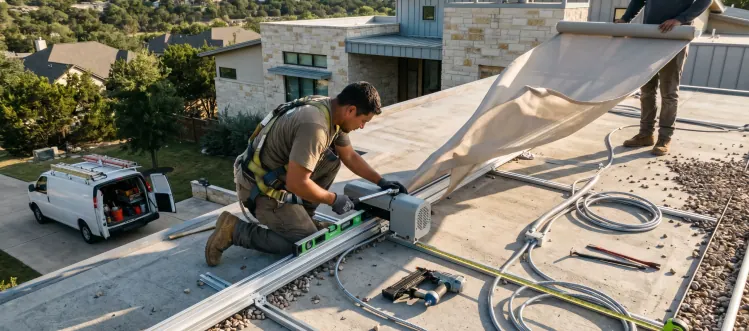
Professional motorized roof shade installation requires six specialized tools that separate amateur attempts from lasting results. Missing even one can compromise your entire system.
Installing a motorized roof shade system looks deceptively straightforward until you're standing on a roof with the wrong equipment, watching your project timeline evaporate. Most homeowners assume standard construction tools will handle the job, but the precision required for proper motor alignment, weatherproof electrical connections, and fabric tensioning demands specialized equipment that many contractors overlook. The difference between a system that operates smoothly for 15 years versus one that fails within two seasons often comes down to using the right tools during installation.
This list covers the six essential tools that professional installers rely on for motorized roof shade systems across Austin, West Lake Hills, and surrounding areas. Each tool addresses a specific challenge that can make or break your installation, from achieving the precise measurements needed for retractable roof systems to ensuring electrical connections survive Central Texas weather extremes. Whether you're planning a DIY project or vetting contractors, understanding these requirements helps ensure your investment delivers the performance and longevity you expect.
1. Digital Laser Level with Remote Control
A digital laser level with remote capability is the foundation tool that determines whether your motorized roof shade system operates smoothly or binds from day one. Unlike basic bubble levels, these precision instruments project perfectly straight reference lines across distances up to 100 feet, which is essential when mounting track systems that must align within 1/16 inch tolerance. The remote control feature becomes critical when working alone on rooftops, allowing you to adjust the laser position from your mounting location rather than climbing down repeatedly to reposition the unit.
In practice, this tool prevents the cascading alignment issues that plague amateur installations throughout Lakeway and Bee Cave properties. Professional installers use the laser to establish mounting points for pergola beams, ensure tubular motors sit perfectly parallel to prevent fabric bunching, and verify that tensioning cables maintain consistent geometry across the entire span. The investment in a quality unit like those used for structured shade systems pays for itself by eliminating the need to disassemble and realign components when initial measurements prove inaccurate.
Here's a comparison of laser level features for motorized shade installation:
| Feature | Basic Level | Professional Grade | Impact on Installation |
|---|---|---|---|
| Range | 30 feet | 100+ feet | Handles large pergola spans |
| Accuracy | ±1/4 inch | ±1/16 inch | Prevents motor binding |
| Remote Control | Manual only | Wireless remote | Solo installation possible |
| Self-Leveling | Manual setup | Automatic | Faster setup, fewer errors |
| Outdoor Visibility | Indoor use | High-vis laser | Works in bright sunlight |
2. Weatherproof Electrical Junction Box Kit
Weatherproof electrical junction boxes designed for outdoor motor applications solve the most common failure point in motorized roof shade systems across Central Texas. Standard indoor electrical boxes fail within months when exposed to temperature swings from 100°F summer heat to occasional freezing, allowing moisture infiltration that corrodes connections and trips breakers. Professional-grade outdoor junction boxes feature IP65 or higher ratings, with gasket seals and corrosion-resistant materials that maintain electrical integrity through years of weather exposure.
The kit approach matters because motorized shade installations require multiple connection points for motors, sensors, and control modules, each demanding the same level of weather protection. Smart installers in Dripping Springs and Spicewood use these boxes to house Somfy motor connections, wind sensor wiring, and smart home integration modules where they remain accessible for maintenance while staying completely weatherproof. The proper junction box also provides strain relief for motor cables, preventing the wire fatigue that causes intermittent operation as systems cycle through thousands of extend and retract operations.
3. Fabric Tension Measurement Device
A fabric tension measurement device eliminates the guesswork that leads to premature fabric failure or poor operation in motorized roof shade systems. These digital instruments measure the exact pounds of force applied to shade fabrics, ensuring optimal tension that prevents sagging without overstressing the material or motor components. Professional installers know that solution-dyed acrylic fabrics perform best at 40-60 pounds of tension per linear foot, while PVC-coated polyester membranes require 60-80 pounds to maintain proper geometry and wind resistance.
The measurement precision becomes critical when dealing with large spans common in Horseshoe Bay and Steiner Ranch installations, where even small tension variations create visible fabric waves or stress concentration points. What many installers miss is that fabric tension directly affects motor longevity, as under-tensioned systems force motors to work harder during retraction while over-tensioned installations strain gearboxes and reduce cycle life. Using this tool during initial setup and annual maintenance ensures your system maintains the factory-specified balance between performance and component protection.
4. Specialized Anchor and Fastener Installation Kit
The wrong fasteners turn a properly designed motorized roof shade system into a liability waiting for the next thunderstorm to expose the weakness. Standard construction fasteners lack the holding power and corrosion resistance needed for systems that generate significant wind loads and operate in constant weather exposure. Professional anchor kits include epoxy-set concrete anchors rated for 2,000+ pounds pullout strength, stainless steel lag bolts for wood framing, and specialized roof membrane penetration seals that maintain waterproof integrity.
The engineering reality is that motorized shade systems create dynamic loads as fabrics extend and retract, plus static loads when deployed in wind conditions that can exceed 1,000 pounds of uplift force on anchor points. Amateur installations using standard deck screws or generic concrete anchors fail catastrophically during the first significant weather event, often causing property damage beyond the system itself. Proper fastener selection based on substrate material, load calculations per ASCE 7 standards, and corrosion resistance ensures your investment remains secure through decades of Central Texas weather extremes.
Critical Components
- Epoxy-Set Anchors: Chemical anchors that cure inside concrete or masonry holes, providing 2,000+ pound pullout strength and eliminating the expansion stress that cracks substrates over time, essential for pergola post connections.
- 316 Stainless Steel Hardware: Marine-grade fasteners that resist corrosion from humidity and temperature cycling, preventing the galvanic corrosion that weakens connections when dissimilar metals contact aluminum frames.
- Membrane Penetration Seals: Specialized gaskets and flashing designed for roof penetrations that maintain waterproof integrity while accommodating thermal movement, preventing leaks that damage building structures.
The investment in proper fasteners represents less than 5% of total project cost while determining 100% of system reliability and safety. Professional installers in Cedar Park and Rollingwood stock multiple fastener types to match specific substrate conditions discovered during installation, rather than forcing universal solutions that compromise holding power. This approach prevents the costly callbacks and safety issues that plague installations using inadequate fastening systems.
5. Motor Programming and Diagnostic Interface
A motor programming interface transforms motorized roof shade system installation from basic mechanical assembly to precision automation setup. These specialized devices connect directly to tubular motors via proprietary protocols, allowing installers to set travel limits, adjust torque sensitivity, program wind sensor responses, and configure smart home integration parameters. Without this tool, motors operate with factory default settings that rarely match actual installation requirements, leading to incomplete retraction, fabric bunching, or inadequate wind protection responses.
The diagnostic capability proves equally valuable for troubleshooting systems that develop operational issues over time. Professional installers use these interfaces to read motor cycle counts, identify sensor malfunctions, and adjust parameters as fabric stretches or hardware settles during the first year of operation. For Somfy systems popular in Austin area installations, the programming interface enables advanced features like automatic sun tracking, coordinated multi-motor operation, and integration with home automation platforms that transform basic shade control into comprehensive outdoor comfort management.
Here's a breakdown of motor programming capabilities by system type:
| Parameter | Factory Default | Custom Programming | Benefit |
|---|---|---|---|
| Travel Limits | Full motor range | Exact fabric dimensions | Prevents over-extension damage |
| Wind Response | 25 mph threshold | Site-specific settings | Protects against local wind patterns |
| Torque Sensitivity | Maximum power | Fabric-matched settings | Extends motor and fabric life |
| Group Control | Individual operation | Synchronized zones | Coordinated shade management |
| Smart Integration | Basic on/off | Full automation | Weather-responsive operation |
6. Professional Grade Crimping and Wire Management Tools
Professional crimping and wire management tools separate reliable motorized roof shade system electrical connections from the loose, corroded joints that cause 80% of service calls within the first two years. Standard household electrical tools create connections adequate for indoor applications but fail when exposed to thermal cycling, vibration from motor operation, and moisture infiltration common in outdoor installations. Professional crimpers create gas-tight connections that maintain conductivity through thousands of thermal cycles while specialized wire management systems protect cables from UV degradation and mechanical damage.
The wire management component becomes critical in roof-mounted installations where cables must route through varying temperatures, wind movement, and potential contact with sharp edges or abrasive surfaces. Quality installations in San Marcos and New Braunfels use UV-rated cable conduits, strain relief boots, and service loops that accommodate building movement without stressing connections. These tools enable the clean, protected wiring runs that distinguish professional installations from amateur attempts that fail when weather or building settlement stresses poorly secured cables.
Essential Components
- Ratcheting Crimpers: Professional tools that create uniform compression on electrical terminals, ensuring gas-tight connections that resist corrosion and maintain conductivity through thermal cycling and vibration from motor operation.
- UV-Rated Cable Management: Conduits, ties, and protective sleeves designed for outdoor exposure that prevent cable degradation from solar radiation while organizing wire runs for easy maintenance access and professional appearance.
- Waterproof Connector Systems: Marine-grade electrical connectors with positive sealing that eliminate moisture infiltration at connection points, preventing the corrosion that causes intermittent operation and safety hazards.
- Digital Multimeter: Precision testing equipment for verifying proper voltage, continuity, and insulation resistance during installation and troubleshooting, ensuring electrical systems meet safety standards and operate within motor specifications.
The electrical reliability of your motorized roof shade system depends entirely on connection quality and cable protection, making these tools essential for installations expected to operate maintenance-free for years. Professional installers invest in quality crimping and wire management equipment because electrical failures often require extensive disassembly to access and repair, making prevention far more cost-effective than remediation. This attention to electrical detail explains why professionally installed systems in the Austin area consistently outperform DIY attempts in both reliability and longevity.
Building Your Installation Success
These six essential tools represent the difference between a motorized roof shade system that operates flawlessly for decades and one that becomes a source of frustration and expense. Each tool addresses a specific aspect of installation precision that cannot be achieved through improvisation or substitution with standard construction equipment. The investment in proper tools pays for itself through reduced installation time, eliminated callbacks, and systems that perform as designed from day one.
Whether you're planning a DIY installation or evaluating contractors for your Austin area property, understanding these tool requirements helps ensure your project meets professional standards. The contractors who arrive with this complete toolkit demonstrate their commitment to installation quality and long-term system reliability. For complex installations involving energy-efficient shading systems, having the right tools becomes even more critical for achieving the performance benefits that justify the investment.
Author
Lane Frazier has spent 20 years perfecting motorized shade installations across Central Texas, developing expertise in the specialized tools and techniques that ensure lasting system performance. His hands-on experience with everything from simple residential pergolas to complex commercial shading device projects has revealed which tools truly matter for professional results. Lane's approach emphasizes the precision and attention to detail that separate amateur attempts from installations that deliver decades of reliable operation.
Ready For a Quote?
Get your custom shade quote Today.
Free, no-pressure consultation. We measure, photograph, and send a written line-item proposal within a week. Most installs ship in 3–5 weeks.
Call the workshop
(512) 939-3446
Mon–Fri · 8a–5p CT · Austin, TX
Prefer to talk it through? Calls are answered by the same team that builds your quote — no call centers, no gatekeepers.
Custom exterior shades, motorized patio screens, awnings, and interior window treatments for Austin and Central Texas.
How To Contact Us
Austin, TX 78734
Monday - Friday 8 AM - 5 PM
navigate
Copyright © 2026 | Treaty Oak Shade Co. All Rights Reserved. | Privacy Policy