
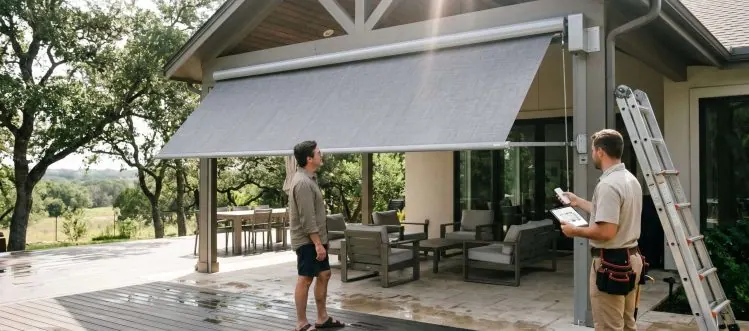
Automated motorized roof shades slash energy costs by up to 30% while protecting your investment from weather damage year-round.
You've invested thousands in outdoor furniture, built the perfect patio space, and created an extension of your home that should be usable year-round. Yet every summer in Austin, that space becomes unbearably hot by 10 AM, and every sudden thunderstorm sends you scrambling to move cushions and close umbrellas. Manual shade systems require constant attention, and forgetting to retract them during high winds can lead to expensive repairs or complete replacement.
Automating your motorized roof shade system transforms this reactive maintenance into a set-it-and-forget-it solution that actively protects your investment. Smart automation goes beyond simple remote control operation, incorporating sensors that respond to wind, rain, and sun conditions without any input from you. This list reveals the specific advantages that make automation worth the investment, from measurable energy savings to protecting your outdoor space during severe weather events common across Austin, West Lake Hills, and surrounding areas.
1. Automatic Weather Protection Prevents Costly Storm Damage
The most expensive lesson homeowners learn about retractable roof systems is what happens when they're deployed during unexpected high winds. A sudden thunderstorm with 40 mph gusts can destroy a $15,000 shade system in minutes, turning fabric into shredded ribbons and bending aluminum frames beyond repair. Manual systems rely entirely on your presence and quick reaction time, which means you're gambling with thousands of dollars every time weather conditions change rapidly.
Automated systems equipped with wind sensors eliminate this risk by monitoring conditions 24/7 and retracting automatically when wind speeds exceed safe thresholds, typically around 22-25 mph. The Somfy Eolis 3D sensor detects not just wind speed but also vibration patterns that indicate dangerous conditions developing. This means your system protects itself even during those sudden Central Texas microbursts that can go from calm to destructive in under five minutes, providing peace of mind whether you're home, at work, or traveling.
Here's how different automation levels protect against common Central Texas weather threats:
| Weather Event | Manual System Risk | Basic Automation | Advanced Automation |
|---|---|---|---|
| Sudden Thunderstorm | Total system loss | Wind sensor retraction | Multi-sensor protection + alerts |
| Overnight Rain | Fabric damage/mold | Manual intervention needed | Automatic rain retraction |
| Microbursts | Frame destruction | Basic wind detection | Vibration + wind monitoring |
| Hail Storms | Fabric punctures | User-dependent retraction | Weather alert integration |
| Extended Heat | UV degradation | No protection | Sun tracking + scheduled operation |
Protection Features
- Wind Detection: Anemometer sensors trigger automatic retraction at programmable wind speeds, preventing fabric tears and frame damage during storms
- Rain Response: Moisture sensors immediately retract fabric covers to prevent water pooling, mold growth, and premature wear from wet conditions
- Vibration Monitoring: Advanced sensors detect structural stress from gusts before visible damage occurs, protecting both fabric and mounting hardware
- Override Protection: Systems prevent manual deployment during unsafe conditions, eliminating user error that leads to weather-related damage
- Storm Mode: Pre-programmed settings automatically secure the system when severe weather alerts are issued for Travis, Hays, or Williamson counties
The cost of replacing a destroyed shade system often exceeds the price difference between manual and automated versions. In practice, most homeowners discover that wind damage happens during the storms they didn't see coming, not the obvious severe weather events they prepared for. Automation essentially provides 24/7 weather monitoring that reacts faster than any homeowner could, turning potential disasters into minor inconveniences.
2. Smart Energy Management Cuts Cooling Costs by 25-35%
Your air conditioning system works overtime when direct sunlight heats your home's exterior walls and windows, particularly on south and west-facing exposures common in Austin area developments. Energy-efficient window coverings can reduce heat gain by up to 77%, but only when they're deployed at the optimal times. Manual systems require you to anticipate sun patterns and remember to adjust coverage throughout the day, which rarely happens consistently enough to maximize energy savings.
Automated systems with sun sensors deploy shading precisely when solar heat gain peaks, typically between 10 AM and 4 PM during Austin's intense summer months. The system calculates optimal deployment based on sun angle, intensity, and your programmed preferences, ensuring maximum cooling benefit without over-shading spaces when natural light is preferred. Homeowners in Lakeway and Bee Cave typically see 25-35% reductions in afternoon cooling costs during peak summer months, with the most significant savings occurring during those brutal 100-degree days when every degree of heat reduction matters.
3. Scheduled Operation Maximizes Outdoor Space Usability
The difference between having an outdoor space and actually using it often comes down to comfort timing. Your patio might be perfect at 8 AM but unbearable by noon, yet manually adjusting shades throughout the day interrupts activities and requires constant attention to changing conditions. Most homeowners end up either leaving shades deployed all day (blocking morning light) or retracted all day (accepting afternoon heat), neither of which optimizes the space for actual use.
Programmable schedules allow your system to automatically create optimal conditions for different activities throughout the day. Morning coffee can happen in natural light with shades retracted, lunch can be shaded and comfortable with partial deployment, and evening entertaining can feature full coverage with integrated lighting. The system learns your patterns and adjusts accordingly, so your outdoor space is always ready for use without requiring any thought or intervention from you.
4. Integration with Smart Home Systems Creates Seamless Control
Modern motorized roof shade systems don't operate in isolation but integrate with existing smart home platforms like Control4, Lutron Caséta, or Somfy TaHoma to create coordinated environmental control. This integration allows your shading to work in concert with lighting, HVAC, and security systems to create scenes that automatically adjust your entire outdoor environment. For example, your 'Evening Entertainment' scene might simultaneously dim patio lights, deploy partial shading, and adjust outdoor speakers to create the perfect ambiance.
Voice control through Alexa or Google Home adds another layer of convenience, allowing you to adjust shading without interrupting conversations or activities. The real advantage emerges when weather changes trigger coordinated responses across multiple systems. A sudden temperature spike might simultaneously close shades, adjust outdoor fan speeds, and modify irrigation schedules, creating a responsive environment that adapts to conditions without requiring multiple manual adjustments throughout the day.
Here's how different smart home integrations enhance motorized shade functionality:
| Platform | Basic Features | Advanced Integration | Voice Control |
|---|---|---|---|
| Lutron Caséta | Scene programming | Lighting coordination | Alexa/Google |
| Control4 | Multi-room control | HVAC integration | Full voice suite |
| Somfy TaHoma | Weather response | Security system sync | Limited voice |
| Apple HomeKit | iOS native control | Automation triggers | Siri integration |
| Samsung SmartThings | Device connectivity | Sensor coordination | Bixby support |
5. Precise Sun Tracking Optimizes Natural Light and Heat Control
The sun's path changes dramatically throughout the year, and what provides perfect shading in June creates excessive darkness in December. Manual adjustments can't keep pace with these seasonal variations, leading to either too much heat during peak summer or insufficient natural light during shorter winter days. Most homeowners settle for compromise positions that work reasonably well year-round but never optimize comfort for current conditions.
Advanced automation systems use astronomical timers and sun position calculations to adjust coverage based on the actual solar angle for your specific location and date. This means your system automatically provides deeper shading during summer's high sun angles while allowing maximum light penetration during winter's lower sun paths. The difference is particularly noticeable in Austin's climate, where December sun angles can be 40+ degrees lower than June peaks, requiring completely different shading strategies for optimal comfort.
Tracking Benefits
- Seasonal Adjustment: Automatic compensation for sun angle changes throughout the year, preventing over-shading in winter and under-shading in summer
- Daily Optimization: Continuous micro-adjustments track the sun's movement, maintaining consistent shade coverage without manual intervention
- Location Precision: GPS-based calculations account for your exact latitude/longitude, ensuring accuracy specific to Austin area properties
The precision of automated sun tracking becomes most apparent during shoulder seasons when manual systems often provide either too much or too little coverage. Spring and fall in Central Texas feature rapidly changing sun angles that manual adjustments can't match, but automated systems seamlessly transition between seasonal settings. This optimization extends the comfortable use of your outdoor space by weeks on both ends of the peak season.
6. Remote Monitoring Enables Management from Anywhere
Traveling during storm season or being stuck at work during an unexpected weather event no longer means worrying about your outdoor investment. Remote monitoring through smartphone apps provides real-time status updates and allows you to control your system from anywhere with internet access. You can check current positions, review recent automated actions, and manually override settings when circumstances require immediate attention.
The peace of mind extends beyond emergency situations to everyday convenience. Forgot to retract shades before leaving for a weekend trip to San Marcos? Handle it from your phone. Want to prepare your patio for guests arriving while you're still at the office in Cedar Park? Deploy shades and check status remotely. This connectivity transforms your motorized roof shade system from a local convenience into a managed asset that you can monitor and control regardless of your physical location.
7. Fabric Longevity Increases Through Optimal Deployment Patterns
Shade fabrics degrade through UV exposure, thermal cycling, and mechanical stress from wind movement. Manual systems often stay in one position for extended periods, creating uneven wear patterns and accelerated degradation in high-stress areas. Alternatively, frequent manual adjustments can create excessive wear on moving parts and connection points. Neither approach optimizes fabric lifespan, leading to premature replacement costs that can exceed $3,000-5,000 for quality systems.
Automated systems optimize deployment patterns to minimize fabric stress while maximizing protection. The system can rotate between partial and full deployment to distribute mechanical stress, retract during high UV periods when shading isn't needed, and avoid unnecessary movements that create wear. Smart algorithms balance protection needs with fabric preservation, often extending usable life by 30-40% compared to manual systems that either over-deploy or under-protect the investment.
Here's how automation extends fabric life compared to manual operation patterns:
| Operation Pattern | Fabric Stress Level | UV Exposure | Expected Lifespan |
|---|---|---|---|
| Manual - Always Deployed | High (constant tension) | Moderate | 6-8 years |
| Manual - Frequent Adjustment | Very High (cycling) | Variable | 5-7 years |
| Manual - Rarely Adjusted | Low | High | 7-9 years |
| Automated - Smart Deployment | Optimized | Minimized | 10-12 years |
| Automated - Weather Response | Protected | Controlled | 12-15 years |
8. Safety Enhancement Through Automatic Emergency Retraction
Manual shade systems create safety risks during emergency situations when rapid retraction becomes necessary. High winds can turn deployed shades into dangerous projectiles, while structural stress from unexpected loads can cause mounting failures that damage property or injure people. The few minutes it takes to manually retract a large system can be the difference between minor inconvenience and major damage, particularly during the sudden severe weather events common in Central Texas.
Emergency retraction protocols in automated systems respond within seconds to dangerous conditions, removing safety hazards before they can cause harm. Engineering controls like these provide the first line of defense against weather-related accidents. Advanced systems can differentiate between normal wind conditions and dangerous gusts, preventing false alarms while ensuring immediate response when safety thresholds are exceeded.
Safety Features
- Instant Response: Sub-30-second retraction times remove safety hazards before dangerous conditions fully develop
- Fail-Safe Design: Power loss triggers automatic retraction to safe positions, preventing storm damage during electrical outages
- Load Monitoring: Strain sensors detect excessive stress and trigger protective retraction before structural failure occurs
- Emergency Override: Manual emergency stops immediately halt operation and retract to safe positions during any perceived danger
The safety benefits become most apparent during those sudden Central Texas weather events that escalate from calm to dangerous in minutes. Automated emergency response eliminates the human reaction time factor, which can be critical when microbursts or severe thunderstorms develop rapidly. This protection extends to both property and personal safety, as properly retracted systems can't become projectiles or create falling debris hazards during severe weather.
9. Consistent Performance Eliminates Human Error and Forgetfulness
The most expensive mistakes with motorized roof shade systems happen when homeowners forget to retract them before storms, deploy them incorrectly for current conditions, or simply don't adjust them frequently enough to optimize performance. Human error accounts for the majority of preventable shade system damage, from leaving systems deployed during high winds to forgetting seasonal adjustments that could prevent UV damage or energy waste.
Automated operation removes the human element from routine decisions while maintaining override capability when manual control is desired. The system never forgets to check weather conditions, never fails to adjust for seasonal changes, and never makes decisions based on incomplete information. This consistency ensures optimal performance day after day, regardless of your schedule, travel plans, or attention to outdoor conditions.
Reliability Advantages
- Perfect Memory: Systems never forget programmed schedules, seasonal adjustments, or safety protocols regardless of user availability
- Consistent Logic: Decisions based on sensor data and programmed parameters eliminate emotional or convenience-based choices that compromise performance
- 24/7 Operation: Continuous monitoring and response capability that doesn't depend on human presence or attention
- Error Prevention: Automated safety checks prevent deployment during unsafe conditions, eliminating costly mistakes from manual operation
The reliability factor becomes most valuable during busy periods when outdoor comfort isn't your primary focus but still matters for daily life. Automated systems maintain optimal conditions during work deadlines, family events, or travel periods when manual attention to shade management would be impossible. This consistency ensures your outdoor investment continues performing optimally regardless of how much attention you can dedicate to its operation.
10. Property Value Enhancement Through Premium Smart Home Features
Automated motorized roof shade systems represent premium smart home technology that appeals to buyers seeking move-in-ready outdoor living solutions. Properties in Dripping Springs, Steiner Ranch, and similar developments increasingly compete on smart home features, and automated shading demonstrates both technological sophistication and practical outdoor living optimization. The system becomes a selling point that differentiates your property from others with basic or no outdoor shading solutions.
Real estate professionals in the Austin area report that automated outdoor systems add measurable value, particularly in higher-end markets where outdoor living is expected rather than optional. The combination of energy efficiency, weather protection, and smart home integration appeals to buyers who understand the cost and complexity of adding these features after purchase. Quality installations often return 60-80% of their investment value while providing years of practical benefit before any sale consideration.
Value Factors
- Smart Home Appeal: Integration with popular platforms like Control4 or Lutron adds to overall home automation value proposition
- Energy Efficiency: Documented cooling cost reductions appeal to environmentally conscious buyers concerned about utility costs
- Low Maintenance: Automated weather protection and optimal operation patterns reduce ongoing maintenance requirements for new owners
- Outdoor Living: Enhanced usability of outdoor spaces increases effective living area and entertainment capability
- Technology Integration: Professional installation and quality components demonstrate attention to detail and premium home features
The value enhancement extends beyond simple dollar amounts to include the lifestyle benefits that make properties more attractive to potential buyers. Automated outdoor shading systems represent the type of thoughtful upgrade that suggests overall property quality and owner investment in long-term comfort and efficiency. In Austin's competitive real estate market, these distinguishing features can accelerate sales and support premium pricing for properties with well-designed outdoor living spaces.
Maximizing Your Outdoor Investment
Automating your motorized roof shade system transforms a reactive maintenance task into a proactive asset management strategy. The combination of weather protection, energy savings, and convenience creates a system that pays for itself through prevented damage and reduced cooling costs while dramatically improving your outdoor space's usability. Smart automation eliminates the guesswork and constant attention that manual systems require, ensuring optimal performance regardless of changing weather conditions or your availability to manage the system.
If you're considering upgrading to automated motorized shades or installing a new system across Austin, West Lake Hills, Lakeway, or surrounding areas, the technology has matured to the point where automation should be considered essential rather than optional. The peace of mind from weather protection alone often justifies the investment, while the energy savings and enhanced convenience provide ongoing value that compounds over years of ownership.
Author
Lane Frazier brings two decades of hands-on experience installing and servicing motorized shade systems throughout the Austin area, from Horseshoe Bay to San Marcos. His expertise with automation technologies like Somfy sensors and smart home integration has helped hundreds of homeowners optimize their outdoor spaces for year-round comfort and protection. Lane's practical approach focuses on matching automation features to Central Texas weather patterns and lifestyle needs rather than simply adding technology for its own sake.
Ready For a Quote?
Get your custom shade quote Today.
Free, no-pressure consultation. We measure, photograph, and send a written line-item proposal within a week. Most installs ship in 3–5 weeks.
Call the workshop
(512) 939-3446
Mon–Fri · 8a–5p CT · Austin, TX
Prefer to talk it through? Calls are answered by the same team that builds your quote — no call centers, no gatekeepers.
Custom exterior shades, motorized patio screens, awnings, and interior window treatments for Austin and Central Texas.
How To Contact Us
Austin, TX 78734
Monday - Friday 8 AM - 5 PM
navigate
Copyright © 2026 | Treaty Oak Shade Co. All Rights Reserved. | Privacy Policy